
The Fruit That Conquered a Nation's Table: Ackee and the Making of Jamaican Identity
Culinary History & Botanical Heritage
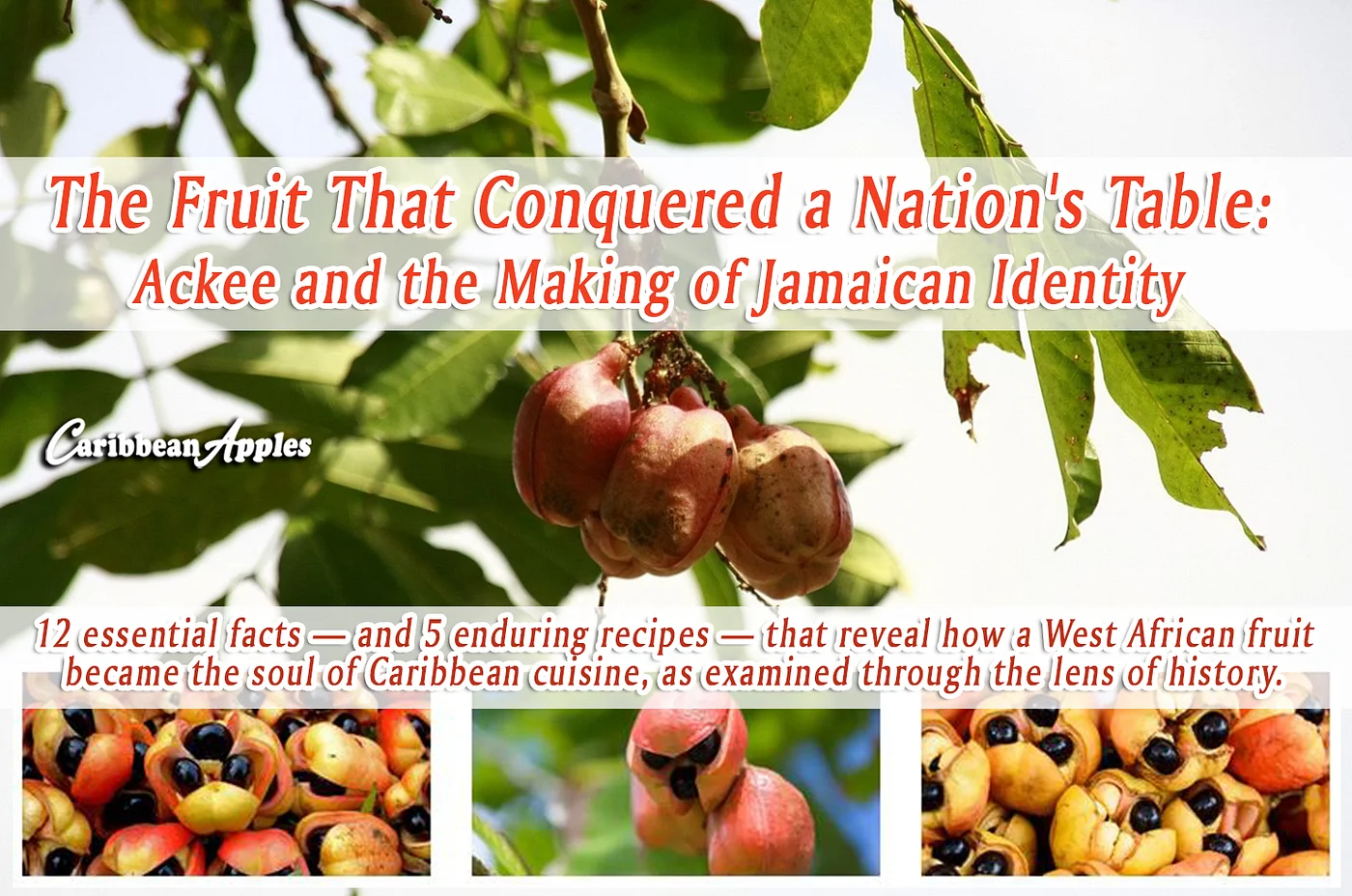
12 essential facts — and 5 enduring recipes — that reveal how a West African fruit became the soul of Caribbean cuisine, as examined through the lens of history.
Twelve Historical Facts
FACT 01
African origins, not Caribbean
Ackee (Blighia sapida) is indigenous to West Africa, specifically the coastal regions of Ghana, Ivory Coast, and Cameroon, where it grew wild long before its transatlantic journey.
FACT 02
Named for a British sea captain
The botanical name Blighia sapida honors Captain William Bligh of HMS Bounty fame, who transported ackee specimens from Jamaica to Kew Gardens, London, in 1793.
FACT 03
Arrived via the slave trade
Ackee seeds likely arrived in Jamaica between 1650 and 1750, carried on slave ships from West Africa. Enslaved Africans brought knowledge of the fruit alongside it, ensuring its cultivation.
FACT 04
Deadlier than it appears
Unripe ackee contains hypoglycin A and B — toxins that can cause Jamaican Vomiting Sickness, a potentially fatal illness. Only fruit that has naturally opened on the tree is safe to eat.
FACT 05
Jamaica's national fruit since 1687
Though formally recognized much later, ackee has been central to Jamaican foodways since the late 17th century, when it became a staple calorie source for enslaved plantation workers.
FACT 06
Banned for decades in the United States
The FDA restricted fresh ackee imports to the US until 2000, citing toxicity concerns. Only canned, brine-preserved ackee — which neutralizes the toxins — was permitted, limiting Jamaican diaspora access.
FACT 07
Part of the soapberry family
Ackee belongs to the Sapindaceae family, making it a botanical relative of lychee, longan, and rambutan — fruits of Asia — a testament to the tropics' shared evolutionary heritage.
FACT 08
The tree is deeply symbolic
In Jamaica, the ackee tree is planted at homesteads as a symbol of rootedness and provision. Cutting one down is historically considered an ill omen, reflecting deep cultural reverence.
FACT 09
Nutritionally formidable
Ackee's creamy arils are rich in essential fatty acids, protein, vitamins B1, B2, B3, and zinc — making it a nutritional powerhouse that sustained generations of workers through grueling labor.
FACT 10
Reaches maturity over many months
An ackee tree takes three to five years to bear fruit after planting. This slow cultivation cycle made it a mark of long-term community settlement — a food of permanence, not transience.
FACT 11
A post-emancipation economic crop
After emancipation in 1838, freed Jamaicans cultivated ackee in their personal provision grounds. It became a symbol of food sovereignty — a crop grown for self-sustenance, not colonial export.
FACT 12
Embedded in Jamaica's national identity
In 1962, ackee and saltfish was declared Jamaica's national dish at independence. The pairing of an African fruit with salt-cured North Atlantic cod reflects Jamaica's complex, layered colonial history.
Five Culinary Applications
I
Ackee and saltfish — the national dish
Sautéed with salted codfish, Scotch bonnet peppers, onions, and tomatoes, ackee's buttery arils absorb the brine and heat into a deeply savory breakfast centerpiece, typically served with boiled green banana, fried dumplings, and callaloo.
II
Ackee curry
Gently folded into a coconut milk curry base with potatoes, chickpeas, and warm spices, ackee serves as a plant-based protein substitute — its firm, egg-like texture holding shape beautifully through a long simmer.
III
Ackee scramble — the vegan breakfast
Mashed with turmeric, black salt (kala namak), diced scallion, and sweet pepper, ackee mimics scrambled eggs so convincingly that it has become a cornerstone of Jamaican plant-based cooking, served on toast or alongside roasted breadfruit.
IV
Ackee soup
Incorporated into a rustic vegetable or chicken broth alongside yellow yam, cho cho, and pumpkin, ackee breaks down slightly to lend a silky richness to the broth — a restorative, homespun dish with deep roots in rural Jamaican cooking.
V
Ackee rice — a festive staple
Folded into coconut rice alongside kidney beans or pigeon peas, ackee adds a nutty creaminess that elevates the dish beyond its humble ingredients. Served at Sunday dinners and celebrations, it represents ackee at its most communal.
Prepared in the tradition of culinary history · Sources drawn from botanical records, colonial archives, and the living oral tradition of Jamaican cooks
Jamaicans treat ackee not just as an ingredient, but as a historical document in fruit form — a living record of migration, resilience, and identity.
CaribbeanApples.com






Compass - Jamaica - Vintage Gold | Unisex Hooded Long Sleeve Tee | 5 Colors
CaribbeanApples.com Exclusive
Compass - Jamaica
Vintage Gold
5 Colors
100% airlume combed and ringspun cotton
Heather colors are 52% cotton, 48% polyester
Fabric weight: 3.8 oz/yd² (128.84 g/m²)
Regular fit
Side-seamed construction
Compass - Jamaica - Vintage Gold | Unisex Hooded Long Sleeve Tee | 5 Colors Size Guide

| Size label | Length | Width |
|---|---|---|
|
XS
|
28 1/2
|
17 1/2
|
|
S
|
29 1/2
|
19
|
|
M
|
30 1/2
|
20 1/2
|
|
L
|
31 1/2
|
22
|
|
XL
|
32 1/2
|
23 1/2
|
|
2XL
|
33 1/2
|
25
|