
Grenadian Kitchens · Spice Isle Traditions
A brief guide to the herb that makes Grenadian food speak.
If you ever step into a Grenadian kitchen — whether it is a big restaurant in St. George's or a small wooden house up in the hills of St. Andrew's — one smell will greet you before anything else. Something green, sharp, a little wild, with a depth that no other herb can match. That is shadow beni. And if you do not know shadow beni, my friend, you do not yet know Grenadian food.
"Grenadians say 'shadow beni' but their neighbors say 'chadon beni,' 'culantro,' 'bandhania' — the herb has travelled the whole world, but it always feels most at home in Grenada."
What is shadow beni?
Shadow beni (Eryngium foetidum) is a broad-leafed herb with serrated, saw-like edges that grows close to the ground. It belongs to the carrot family — the same family as your regular cilantro — but do not make the mistake of treating them as equals. Shadow beni is bolder, more pungent, and far more persistent. Where cilantro wilts in heat and loses its scent, shadow beni holds firm. It thrives in our tropical sun, in damp soil, growing in patches along fence lines and kitchen gardens all over the island. The flavor is like cilantro turned up to three times the volume, with a faint citrus edge and an almost anise-like warmth underneath.
The name "shadow beni" — which is use throughout the English-speaking Caribbean — is thought to derive from the French "chardon béni," meaning "blessed thistle," a nod to both its serrated leaves and its perceived healing properties. In Trinidad and Tobago they say "chadon beni." In South America, where it is also widely used, you will hear "culantro" or "recao." But Grenadians have always called it shadow beni, and that name carries all the history in it.
A brief history
Shadow beni is native to tropical America and the Caribbean, and it has been cultivated and used in cooking throughout the region for centuries. It was well established in the kitchens of indigenous Carib and Arawak peoples long before European contact — used not only for flavor, but as a medicinal plant to treat fevers, chills, and stomach ailments. When the French and later the British colonized Grenada, and when enslaved Africans were brought to the island, they encountered this herb growing wild in the forests and adopted it wholeheartedly into their cooking. It was practical: it grew without much effort, it kept in heat without wilting, and it gave dishes an aroma that simply could not be replicated with dried spices from Europe.
Through the centuries of plantation life and the eventual emergence of a distinctly Grenadian cuisine, shadow beni became woven into the culinary identity the way nutmeg and mace became an agricultural identity. After emancipation in 1834, when freed people established their own gardens and kitchens, shadow beni was one of the first herbs planted. It was the people's herb — free, abundant, powerful. Today it remains a staple in every market, every garden, and every serious cook's repertoire on the island.
Shadow beni in Grenadian dishes
There are very few savory dishes in Grenada’s tradition that do not benefit from shadow beni. Here are the ones where you will feel its presence most powerfully:
Oil Down
The national dish — shadow beni is essential in the seasoning base alongside coconut milk and breadfruit
Stewed Chicken
Marinated overnight in green seasoning where shadow beni leads the flavor
Fish Broth
Added fresh toward the end so the herb perfumes the whole pot
Callaloo Soup
Blended into the creamy dasheen leaf base to lift the earthiness
Pelau
The rice-and-pigeon-pea one-pot draws deep flavor from shadow beni in the sofrito
Curry Dishes
Lamb and goat curries use it to balance the heat of the curry powder
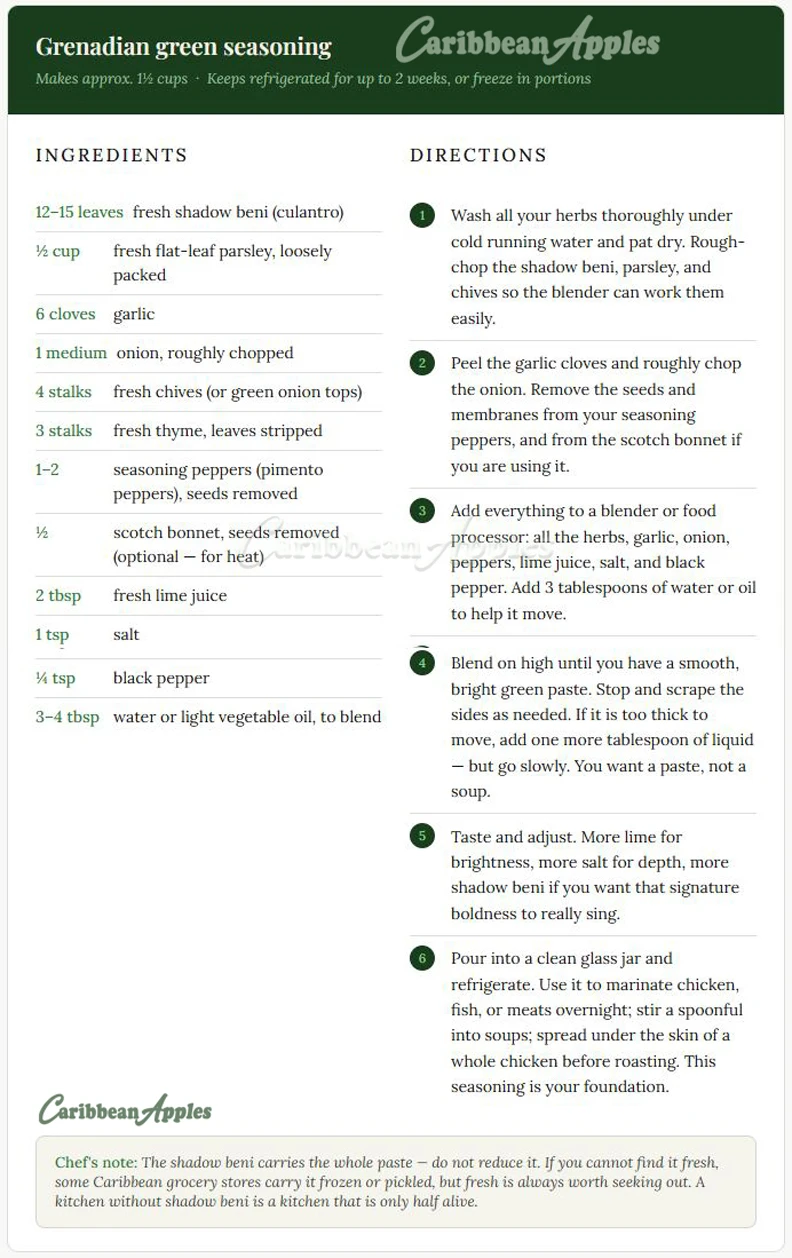
Beyond any single dish, the most important use of shadow beni on the island is in green seasoning — the all-purpose marinade and flavor paste that is the true heart of Grenadian cooking. Every family has their version, passed down through generations, adjusted here and there, but always with shadow beni at the center. - See shared recipe.
Put on that Chef's Apron and make your own Grenadian Green Seasoning
CaribbeanApples.com