Image
Pinned

CaribbeanApples.com

Island to island through the 

A snapshot of the islands — their history, their flavors, their people, and the peculiar magic that seems to live in the salt air between them.

The Lesser Antilles: A Chain of Wonders

First, a little geography. The Lesser Antilles — also known as the Caribbees — stretch like a long chain between the eastern edge of the warm Caribbean Sea and the vast Atlantic Ocean, located to the east and south of the Greater Antilles, with some islands found just off the northern coast of South America. They divide into two main arcs: the Leeward Islands in the north and the Windward Islands curving south. Most of the islands were formed by volcanoes over millions of years, as tectonic plates moved and magma pushed up from deep within the Earth, creating underwater volcanoes that eventually broke the ocean surface.

According to the Caribbean Tourism Organization, the region welcomed an estimated 34.2 million international tourist arrivals in 2024, a 6.1% increase over 2023 and a 6.9% rise above pre-pandemic levels. The cruise sector was equally impressive, with 33.7 million cruise visits in 2024 — a 10.3% increase over 2023 and 10.9% above pre-pandemic levels. By 2025, stay-over arrivals grew another 2.5%, reaching approximately 35 million visits, with cruise tourism expanding 5.2% to roughly 35.5 million — representing a 16.7% increase compared to 2019 levels.

In practical terms, visitors reach these islands one of three ways: by air into each island's international airport, by cruise ship docking at port towns, or by inter-island ferries for shorter hops between nearby islands. A 15% increase in seat capacity between North America and the Caribbean in recent years helped widen air access considerably, while luxury cruise itineraries have expanded options for sea travel.

We start with Barbados first, then move northward through the Windwards and into the Leewards.

🌺 Barbados — The Gem of the East

A Brief History

Barbados is the easternmost island in the Lesser Antilles and has a population that reflects a diverse mix of ethnicities and traditions, influenced by its colonial past and African heritage. The island was inhabited first by the Arawak people, then the Caribs, before the Portuguese arrived in 1536 and the British established a colony in 1627. Sugar cultivation, built on the brutal labor of enslaved Africans, dominated island life for centuries. Barbados gained independence from Britain on November 30, 1966, and became a republic in November 2021 — a historic moment that made global headlines.

Bridgetown, Barbados is listed as a UNESCO World Heritage Site. Barbadians are colloquially called Bajans (pronounced "bay-juhns").

What It's Known For

Barbados is known for its stunning white sand beaches, world-class cricket, and its beloved rum — Mount Gay Rum, produced here since 1703, is widely considered the world's oldest rum brand. The island is also celebrated as the birthplace of pop icon Rihanna and has a sophisticated culinary and arts scene that punches well above its small size.

Fun fact: the citrus fruit grapefruit originated in Barbados, a natural hybrid of the sweet orange and the pomelo. The national fruit is the golden apple (also called June plum).

Culinary Identity

Flying Fish and Cou-Cou is the national dish of Barbados. The Cou-Cou is cornmeal prepared with onions, okra, and thyme, topped with crispy fillets of Flying Fish. The flying fish is skillfully boned, then rolled and stewed in a gravy of herbs, tomatoes, garlic, onions, and butter.

Another beloved dish is Pudding and Souse. The Souse refers to pork that's been boiled and pickled with onion, lime, cucumber, and peppers. It's served with pudding made of steamed sweet potatoes, herbs, and peppers — best enjoyed cold and traditionally eaten as a Saturday luncheon.

Recipe: Bajan Flying Fish Stew

Serves 4

Ingredients:

  • 4 whole flying fish, cleaned and boned (or substitute small sea bass fillets)
  • Juice of 2 limes
  • 1 tsp salt, ½ tsp black pepper
  • 1 tsp Bajan seasoning (blend of thyme, marjoram, garlic, onion, and hot pepper)
  • 2 tbsp vegetable oil
  • 1 medium onion, finely diced
  • 3 cloves garlic, minced
  • 2 medium tomatoes, diced
  • 1 cup water or fish stock
  • 1 tbsp butter
  • Fresh thyme sprigs
  • 1 small scotch bonnet pepper, whole (for heat without fire — don't break it)

Directions:

  1. Rinse fish with lime juice and cold water. Season with salt, pepper, and Bajan seasoning. Allow to marinate for at least 30 minutes.
  2. Roll each fish fillet and secure with a toothpick.
  3. Heat oil in a wide skillet over medium heat. Sauté onion and garlic until soft and fragrant, about 5 minutes.
  4. Add tomatoes, thyme, and the whole scotch bonnet. Cook 3–4 minutes until tomatoes soften.
  5. Pour in water or stock. Bring to a gentle simmer.
  6. Add fish rolls carefully. Cover and cook on low heat for 10–12 minutes until fish is just cooked through.
  7. Stir in butter. Adjust salt. Remove toothpicks and scotch bonnet before serving.
  8. Serve over Cou-Cou (cornmeal cooked with okra) or plain rice.

Recipe: Saturday Souse

Serves 6–8 as a cold lunch

Ingredients:

  • 2 lbs pork shoulder or pig's feet, cleaned
  • 1 tsp salt
  • Water to cover
  • Juice of 4 limes
  • Juice of 1 orange
  • 1 cucumber, thinly sliced
  • 1 medium onion, thinly sliced
  • 1 small hot pepper, minced (or to taste)
  • Fresh parsley, chopped
  • Salt to taste

Directions:

  1. Place pork in a large pot, cover with water, add salt. Bring to a boil, then reduce heat and simmer 1.5 to 2 hours until meat is very tender.
  2. Drain and allow to cool. Slice or shred meat into bite-sized pieces.
  3. In a large bowl, combine lime juice, orange juice, onion, cucumber, hot pepper, and parsley.
  4. Add cooled pork. Toss well. Season with salt.
  5. Refrigerate for at least 1 hour — the longer the better.
  6. Serve cold with sweet potato pudding or crusty bread.

🌿 Grenada — The Spice Isle

A Brief History

Grenada, southernmost of the Lesser Antilles, was home to the Ciboney and later the Arawaks and Caribs before Europeans arrived. The French colonized the island in 1649 and introduced African enslaved labor to cultivate tobacco and sugar. Britain gained control in 1762 after years of conflict. Grenada achieved independence in 1974. In 1983, the island became the center of Cold War-era tension when the United States launched a military intervention following a coup — an event that older Grenadians still reference with a complicated mix of gratitude and ambivalence.

Today, Grenada is peaceful, proud, and wonderfully fragrant.

What It's Known For

Grenada is made up of several islands including the large island of Grenada and the farthest southern Grenadine Islands, encompassing Carriacou and Petite Martinique. It is called the "Spice Isle" because it produces roughly one-fifth of the world's nutmeg supply, along with cinnamon, cloves, ginger, turmeric, and bay leaves. The national fruit is the nutmeg — yes, the spice is technically the seed inside the fruit. Mace, another spice, comes from the red lacy covering of the same seed. The Grenadian flag even features a stylized nutmeg.

Culinary Identity

The national dish of Grenada is Oil Down — made with ground provisions including breadfruit, served with pigtail, salt beef, or your choice of meat. The technique of "packing the pot" is used to create this dish: breadfruit and meat go in the bottom, vegetables in the middle, and callaloo leaves and dumplings on top, perfectly spiced with turmeric. Oil Down gets its name from the mixture of coconut oil and meat juices that settle at the bottom of the pot.

Recipe: Grenadian Oil Down

Serves 6–8

Ingredients:

  • 1 medium breadfruit, peeled, cored, and cubed
  • 1 lb salted pigtail or salt beef, soaked overnight, drained, and cut into pieces
  • 1 lb chicken pieces (optional)
  • 2 cups callaloo leaves (or spinach), roughly chopped
  • 2 cups coconut milk
  • 1 cup water
  • 1 onion, sliced
  • 4 cloves garlic, crushed
  • 2 sprigs fresh thyme
  • 1 tsp turmeric
  • 1 whole scotch bonnet pepper (do not break)
  • Salt to taste

For dumplings:

  • 1 cup flour, ½ tsp salt, water to mix into stiff dough

Directions:

  1. In a large heavy pot, layer salted meat at the bottom. Add chicken if using.
  2. Add breadfruit pieces, then onion, garlic, and thyme.
  3. Layer callaloo leaves on top. Tuck the whole scotch bonnet in the side.
  4. Mix coconut milk and water; pour over everything. Sprinkle turmeric on top.
  5. Roll dumpling dough into small oval shapes and nestle them in.
  6. Cover tightly. Cook on medium-low heat for 45–60 minutes until the liquid is absorbed and the bottom develops a slight caramelized crust (this is the "oil down").
  7. Do not stir — the layers are the secret.
  8. Serve communally, straight from the pot.

Recipe: Grenadian Cocoa Tea (Spiced Hot Chocolate)

Serves 4

Ingredients:

  • 4 Grenadian cocoa sticks (or 4 tbsp unsweetened cocoa powder)
  • 4 cups water
  • 1 cup evaporated milk
  • 1 cinnamon stick
  • 3 whole cloves
  • 1 tsp freshly grated nutmeg
  • Sugar to taste
  • 1 tsp vanilla extract

Directions:

  1. Bring water to a boil with cinnamon and cloves.
  2. Add cocoa sticks or powder, whisking vigorously to prevent lumps.
  3. Reduce heat. Simmer 10 minutes.
  4. Add evaporated milk, vanilla, and nutmeg. Stir well.
  5. Sweeten to taste.
  6. Strain and serve hot. The aroma alone will make your morning.

🌊 St. Lucia — The Helen of the West Indies

A Brief History

St. Lucia, often called the "Helen of the West Indies" for its breathtaking beauty, changed European hands fourteen times between the French and British — more than any other Caribbean island — before finally becoming a British colony in 1814 and gaining independence in 1979. Its dual French and British heritage is evident in everything from place names to cuisine to the Kwéyòl (Creole) language spoken alongside English.

The dramatic twin volcanic peaks — the Pitons, Gros Piton and Petit Piton — were declared a UNESCO World Heritage Site in 2004.

What It's Known For

St. Lucia is celebrated for its volcanic landscape, lush rainforests, sulphur springs (you can literally bathe in volcanic mud), and the extraordinary natural harbor at Castries. The national fruit is the cocoa pod. The island is also famous for its jazz festival, its award-winning resorts, and its contribution to literature: Nobel Prize–winning poet and playwright Derek Walcott was born here.

Culinary Identity

The national dish of St. Lucia is Green Fig and Saltfish. The "green figs" are actually unripe bananas or plantain, boiled and paired with saltfish done up with herbs and spices. It is typically served as a hearty breakfast. Other beloved dishes include bouyon (a rich meat and root vegetable broth) and banana bread made from the island's abundant fruit.

Recipe: St. Lucian Green Fig and Saltfish

Serves 4

Ingredients:

  • 8–10 green bananas (unripe, firm)
  • 1 lb salted codfish (saltfish), soaked overnight, rinsed, and flaked
  • 2 tbsp vegetable oil
  • 1 medium onion, sliced
  • 3 cloves garlic, minced
  • 1 bell pepper, sliced
  • 2 medium tomatoes, diced
  • 1 sprig fresh thyme
  • 1 tsp black pepper
  • Fresh chives and parsley to garnish

Directions:

  1. Bring a pot of lightly salted water to a boil. Cut tips off green bananas but leave skins on (this prevents blackening). Boil 20–25 minutes until tender. Drain, peel, and slice into rounds.
  2. Rinse soaked saltfish. Boil 10 minutes to reduce salt further. Drain and flake into pieces, removing any bones and skin.
  3. Heat oil in a skillet. Sauté onion and garlic until translucent.
  4. Add bell pepper, tomatoes, and thyme. Cook 4–5 minutes until softened.
  5. Add flaked saltfish. Stir and cook 3–4 more minutes.
  6. Gently fold in sliced green bananas. Season with black pepper.
  7. Garnish with chives and parsley. Serve warm.

Recipe: St. Lucian Banana Bread with Rum Glaze

Makes 1 loaf

Ingredients:

  • 3 ripe bananas, mashed
  • 1/3 cup melted butter
  • ¾ cup sugar
  • 1 egg, beaten
  • 1 tsp vanilla
  • 1 tsp baking soda
  • Pinch of salt
  • 1½ cups all-purpose flour
  • ½ tsp cinnamon, ¼ tsp nutmeg

For rum glaze:

  • 2 tbsp dark rum (use local St. Lucian Chairman's Reserve if possible)
  • ½ cup powdered sugar

Directions:

  1. Preheat oven to 350°F (175°C). Grease a 9x5 loaf pan.
  2. Stir melted butter into mashed bananas.
  3. Mix in sugar, beaten egg, and vanilla.
  4. Sprinkle in baking soda and salt. Stir in flour, cinnamon, and nutmeg until just combined.
  5. Pour into pan. Bake 55–65 minutes until a toothpick comes out clean.
  6. While warm, whisk together rum and powdered sugar. Drizzle over loaf.
  7. Allow to cool 10 minutes before slicing.

🍞 St. Vincent & the Grenadines — The Land of the Blessed

A Brief History

St. Vincent called itself Hairouna — "Land of the Blessed" — long before any European arrived. The island was settled first by the Ciboney, then the Arawaks, and finally the Caribs, who proved so fiercely protective of their land that St. Vincent was one of the last Caribbean islands to fall to European colonizers. African enslaved people who escaped from Barbados, St. Lucia, and Grenada sought refuge here, intermarrying with the Caribs to become the Garifuna — also called Black Caribs — a proud and distinct people whose descendants still live on the island today. In 1797, after a prolonged resistance, more than 5,000 Garifuna were forcibly deported by the British to the island of Roatan (now in Honduras), where their English-speaking descendants survive to this day as a recognized Caribbean people.

The French cultivated coffee, tobacco, indigo, and sugar on St. Vincent beginning in 1719, but Britain ultimately prevailed, holding the island under the Treaty of Paris in 1783. St. Vincent and the Grenadines gained independence in 1979. The nation includes not just the main island of St. Vincent but a string of smaller Grenadine gems — Bequia, Canouan, Mayreau, Mustique, Union Island, and the marine wildlife reserve of the Tobago Cays.

What It's Known For

St. Vincent is known for its dramatic volcanic landscape — including La Soufrière, an active volcano that erupted as recently as 2021 — its lush black-sand beaches, and its status as the arrowroot capital of the world, the island producing a significant share of the global supply of this starchy root. The Grenadines are among the finest sailing waters in the Caribbean, beloved by yachters and divers. Mustique has long been famous as a hideaway for royalty and celebrities. Bequia is celebrated for its traditional boat-building culture and warm, unhurried harbor village atmosphere.

The national fruit of St. Vincent and the Grenadines is the breadfruit — fitting, given that the island hosts an entire month-long Breadfruit Festival each August celebrating the over 25 varieties grown here. Breadfruit arrived in the Caribbean via Captain William Bligh of HMS Bounty fame in the late 18th century, originally introduced as cheap food for enslaved laborers. It took root in Vincentian soil so deeply that it became the soul of the island's cuisine.

Culinary Identity

The national dish is Roasted Breadfruit and Fried Jackfish. The whole breadfruit is roasted over an open flame until its outer skin chars and blackens, while the interior becomes tender and aromatic —tasting a little like a cross between a sourdough roll and a roasted potato. The jackfish hits screaming-hot oil whole, its skin blistering into crispy shards while the flesh stays flaky and white. They are served together, usually with golden apple juice on the side.

Madongo dumplings — made from arrowroot, nutmeg, and coconut — are another beloved Vincentian specialty. The daily dish in most households is pilau, a preparation of rice and pigeon peas to which any available meat or fish is added. The national beer, Hairoun Lager, is named after the Carib word for St. Vincent itself.

Recipe: Roasted Breadfruit with Garlic Butter

Serves 4–6 as a side

Ingredients:

  • 1 whole ripe breadfruit (firm but giving slightly to pressure)
  • 4 tbsp salted butter, softened
  • 3 cloves garlic, finely minced
  • 1 tsp fresh thyme leaves
  • Salt and black pepper to taste
  • Fresh parsley, chopped

Directions:

  1. If cooking over an open flame (ideal): place whole breadfruit directly on a gas burner or outdoor grill over medium-high heat. Turn with tongs every 5–7 minutes, allowing the skin to char and blacken on all sides. Cook 35–45 minutes until a skewer meets no resistance in the center.
  2. If using an oven: preheat to 400°F (200°C). Prick breadfruit all over with a fork. Place on a baking tray. Roast 60–75 minutes, turning once, until fully soft.
  3. While breadfruit roasts, mix butter with garlic, thyme, salt, and pepper.
  4. Allow breadfruit to cool slightly. Cut in half, remove the core, and scoop the soft interior into chunks — or peel the charred skin away entirely.
  5. Toss hot breadfruit with garlic butter until melted and fragrant.
  6. Garnish with parsley. Serve immediately alongside fried jackfish, saltfish, or stewed meat.

Recipe: Vincentian Madongo Dumplings (Arrowroot Dumplings)

Makes about 16 dumplings

Ingredients:

  • 1½ cups arrowroot flour (or substitute half arrowroot, half all-purpose flour)
  • ½ cup freshly grated coconut
  • 1 tbsp sugar
  • ½ tsp freshly grated nutmeg
  • ¼ tsp cinnamon
  • Pinch of salt
  • Cold water to bring dough together (approximately ½ cup)
  • Oil for shallow frying

Directions:

  1. In a bowl, combine arrowroot flour, grated coconut, sugar, nutmeg, cinnamon, and salt. Mix well.
  2. Add cold water gradually, stirring until a firm but pliable dough forms. It should not be sticky.
  3. Divide dough into 16 pieces. Roll each into a smooth ball, then flatten slightly into a disc.
  4. Heat about ½ inch of oil in a skillet over medium heat. Fry dumplings in batches, 3–4 minutes per side, until golden and cooked through.
  5. Drain on paper towels.
  6. Serve warm as a side dish with saltfish or fried jackfish, or enjoyed on their own as a snack with a drizzle of honey.

🦀 Trinidad & Tobago — Where Africa, India, and the Caribbean Meet

A Brief History

Trinidad and Tobago are the southernmost islands of the Lesser Antilles, sitting just off the Venezuelan coast. Trinidad was home to the Arawak and Carib peoples before Christopher Columbus arrived in 1498. Spain colonized it, then Britain seized control in 1797. After the abolition of slavery, the British brought hundreds of thousands of indentured laborers from India — a wave of migration that profoundly shaped the islands' culture, religion, and cuisine. The twin-island nation gained independence in 1962 and became a republic in 1976.

Tobago has a quieter, more pastoral history, known historically for conflicts between Dutch, English, and French colonizers before Britain consolidated control.

What It's Known For

Trinidad is the birthplace of Carnival — the greatest show on Earth, many argue — steelpan music (invented here), and soca and calypso music. The national fruit of Trinidad and Tobago is the chenette (also called guinep), a small green fruit with a tangy-sweet flesh. Tobago is known for its pristine reefs, diving, and the legend of Robinson Crusoe, whose story was said to be inspired by its shores.

Culinary Identity

The national dish of Trinidad and Tobago is Crab and Callaloo — a dark green soupy concoction made of callaloo greens, well-seasoned and blended almost like a velvety stew. The Indian heritage shows up spectacularly in the street food: doubles (fried bara bread with curried chickpeas), roti, and curried crab are everywhere.

Recipe: Trinidadian Doubles

Makes 10–12 doubles

For the bara (fried bread):

  • 2 cups all-purpose flour
  • 1 tsp instant yeast
  • 1 tsp sugar
  • 1 tsp salt
  • 1 tsp ground cumin (geera)
  • ½ tsp turmeric
  • ¾ cup warm water (approximately)
  • Oil for deep frying

For the channa (curried chickpeas):

  • 2 cans (15 oz each) chickpeas, drained and rinsed
  • 2 tbsp vegetable oil
  • 1 medium onion, diced
  • 4 cloves garlic, minced
  • 2 tbsp curry powder
  • 1 tsp cumin, 1 tsp turmeric
  • 1½ cups water
  • Salt and pepper to taste
  • Fresh shadow beni (culantro) or cilantro

Directions:

  1. Combine flour, yeast, sugar, salt, cumin, and turmeric. Add water gradually, kneading until a soft dough forms. Cover and rest 1 hour until puffed.
  2. Meanwhile, heat oil and sauté onion and garlic until golden. Add curry powder, cumin, and turmeric; stir 1 minute.
  3. Add chickpeas and water. Simmer 20–25 minutes until thick and saucy. Season with salt and pepper.
  4. Divide dough into 10–12 balls. Flatten each into a thin round (about 4 inches).
  5. Fry in 350°F oil for 30–45 seconds per side until puffed and golden. Drain on paper towels.
  6. To assemble: place two bara flat, spoon on channa, top with shadow beni, tamarind sauce, and pepper sauce to taste.

Recipe: Callaloo Soup

Serves 6

Ingredients:

  • 1 bunch callaloo leaves (or substitute taro leaves or baby spinach)
  • 1 lb fresh crab claws (or cleaned crab pieces)
  • ½ lb salted pigtail or salt pork
  • 1 can coconut milk
  • 2 cups water or chicken stock
  • 1 medium onion, chopped
  • 4 cloves garlic, minced
  • 2 pimento peppers (or sweet Italian peppers), sliced
  • 1 sprig fresh thyme
  • 3 okra, sliced
  • 1 whole scotch bonnet pepper
  • Salt to taste

Directions:

  1. Boil pigtail 20 minutes to reduce salt. Drain.
  2. In a large pot, combine callaloo leaves, pigtail, coconut milk, water, onion, garlic, peppers, thyme, okra, and whole scotch bonnet. Bring to a boil.
  3. Add crab. Reduce heat and simmer 30 minutes.
  4. Remove scotch bonnet. Use an immersion blender or swizzle stick to blend the leafy greens into a smooth, dark green base (leave crab pieces whole).
  5. Season with salt. Simmer 5 more minutes.
  6. Serve over rice or with provision (root vegetables).

🏝️ Antigua & Barbuda — 365 Beaches, One for Every Day

A Brief History

Antigua's indigenous Siboney people date back 4,000 years, followed by the Arawaks and Caribs. Britain colonized Antigua in 1632, and it became one of the most economically significant sugar islands in the British Empire, its wealth built entirely on enslaved African labor. Antigua and Barbuda gained independence together in 1981. Barbuda, the quieter sister island, is famous for its pink sand beaches and frigate bird sanctuary — the largest in the Western Hemisphere.

What It's Known For

Antigua is renowned for its 365 beaches, its annual Sailing Week (one of the world's premier regattas), and a particularly sweet variety of black pineapple — the national fruit — considered by many to be the sweetest pineapple on Earth. Antigua is also closely associated with the legend of Horatio Nelson, who commanded the British naval base at English Harbour.

Culinary Identity

Fungee are cornmeal and okra dumplings which, when served together with pepperpot, form the national dish of Antigua and Barbuda. Pepperpot is simmered in a large pot and features whatever meat is available — salted beef or pigtail. The island also takes pride in its ducana (sweet potato dumplings) and saltfish buljol.

Recipe: Antiguan Ducana (Sweet Potato Dumplings)

Makes about 12 dumplings

Ingredients:

  • 2 lbs sweet potato, grated
  • 1½ cups grated coconut (fresh or frozen)
  • ½ cup flour
  • ¼ cup sugar
  • 1 tsp vanilla
  • 1 tsp mixed spice (or combination of cinnamon, nutmeg, allspice)
  • Banana leaves or foil for wrapping

Directions:

  1. Combine grated sweet potato, coconut, flour, sugar, vanilla, and spice. Mix well into a sticky dough.
  2. Place a heaped spoonful of mixture onto a softened banana leaf (or a square of foil). Wrap tightly, folding ends in.
  3. Place wrapped dumplings in a pot of boiling water. Cook 45–60 minutes.
  4. Carefully unwrap. Ducana should be firm and fragrant.
  5. Serve alongside saltfish or as a sweet treat on their own.

Recipe: Antiguan Pepperpot

Serves 6–8

Ingredients:

  • 1 lb salted pigtail or salt beef, soaked overnight and drained
  • ½ lb fresh pork shoulder, cubed
  • 1 medium onion, chopped
  • 3 cloves garlic, minced
  • 1 bunch spinach or kale, chopped
  • 2 cups callaloo leaves (or additional spinach)
  • 1 cup coconut milk
  • 1½ cups water
  • 6 okra, whole
  • 1 sprig thyme
  • 1 whole scotch bonnet
  • Salt and pepper to taste

Directions:

  1. In a large pot, brown fresh pork with onion and garlic. Add soaked salted meat.
  2. Pour in water. Bring to a boil, then simmer 30 minutes.
  3. Add greens, coconut milk, okra, thyme, and whole scotch bonnet.
  4. Simmer on low heat another 30–40 minutes, stirring occasionally, until greens are fully wilted and stew is thick.
  5. Remove scotch bonnet. Season and serve over rice or with fungee.

🌸 Martinique — The Island of Flowers

A Brief History

Martinique, an overseas region of France, was home to the Arawak and then the Carib peoples before French colonization began in 1635. Like its neighbors, it ran on sugar and enslaved African labor for centuries. Slavery was abolished in the French colonies in 1848, largely due to the advocacy of Martinique-born abolitionist Victor Schœlcher. The island remains part of France to this day, meaning its residents carry French passports and vote in French elections.

The volcanoes and forests of Mount Pelée and the Pitons of Northern Martinique are listed as a UNESCO World Heritage Site. Mount Pelée's 1902 eruption is one of the deadliest in recorded history, devastating the former capital of Saint-Pierre in minutes.

Fun fact: coffee made it to the Americas via one seedling taken from King Louis XIV's coffee plant in the Royal Botanical Garden. The seedling was planted on Martinique, and all coffee trees in the Caribbean, Central America, and South America stem from this single seedling. The whole of Latin American coffee culture traces its roots to one small island.

What It's Known For

Martinique is known for its French Creole culture, its agricultural rhum agricole (made from fresh sugarcane juice rather than molasses — a distinct, more complex spirit), its national fruit the breadfruit, and a cuisine that elegantly marries West African, Creole, and French culinary traditions.

Martinique saw an 11% surge in cruise passenger arrivals in the 2024–2025 season, reflecting growing international interest in the island.

Culinary Identity

The national dish of Martinique is Porc Colombo — a curry stew made of seasoned pork, onions, peppers, tomato, and sweet potato. Accras de morue (fried salt cod fritters) are another beloved staple, sold at every market and roadside stall.

Recipe: Martinique Porc Colombo

Serves 4–6

Ingredients:

  • 2 lbs pork shoulder, cubed
  • 2 tbsp Colombo spice mix (or curry powder with added coriander, cumin, turmeric, and mustard seed)
  • 1 tsp allspice, 1 tsp cinnamon
  • 1 tbsp fresh thyme
  • 3 cloves garlic, minced
  • 1 onion, diced
  • 1 zucchini, cubed
  • 1 medium sweet potato, cubed
  • 2 tomatoes, chopped
  • 1 scotch bonnet pepper, whole
  • 2 tbsp vegetable oil
  • 1 cup water or coconut milk
  • Salt and pepper

Directions:

  1. Toss pork with Colombo spices, allspice, cinnamon, garlic, and thyme. Marinate at least 1 hour (overnight is better).
  2. Heat oil in a Dutch oven or heavy pot. Brown pork in batches. Set aside.
  3. In the same pot, sauté onion until soft. Return pork.
  4. Add tomatoes, sweet potato, zucchini, and whole scotch bonnet. Pour in water or coconut milk.
  5. Simmer covered on low heat 45–55 minutes until pork is tender and sauce is fragrant.
  6. Remove scotch bonnet. Adjust seasoning.
  7. Serve with white rice and fried plantains.

Recipe: Accras de Morue (Martinique Salt Cod Fritters)

Makes about 24 fritters

Ingredients:

  • ½ lb salted codfish, soaked overnight, rinsed, and flaked
  • 1 cup all-purpose flour
  • 1 tsp baking powder
  • 1 egg
  • ½ cup cold water (approximately)
  • 2 green onions, minced
  • 2 cloves garlic, minced
  • 1 scotch bonnet or habanero, finely minced (or to taste)
  • Fresh parsley, chopped
  • Black pepper
  • Oil for deep frying

Directions:

  1. Boil soaked codfish 10 minutes. Drain, cool, and flake finely. Remove bones and skin.
  2. In a bowl, whisk flour, baking powder, egg, and water into a smooth batter.
  3. Fold in flaked fish, green onions, garlic, hot pepper, and parsley. Season with black pepper.
  4. Heat oil to 350°F. Drop batter by tablespoons into oil.
  5. Fry 2–3 minutes per side until golden and crispy.
  6. Drain on paper towels. Serve immediately with lime wedges and hot sauce.

🌋 Dominica — The Nature Isle

A Brief History

Dominica is one of the youngest islands in the Lesser Antilles, geologically speaking — its volcanic interior is still active. The Kalinago (Carib) people held on here longer than anywhere else in the Caribbean, and Dominica today has the only remaining indigenous Carib territory in the Eastern Caribbean. The French and British fought for control of the island repeatedly before Britain retained it after 1805. Dominica gained independence in 1978.

The island is also famous for being one of the first to be struck by Hurricane Maria in September 2017, which devastated roughly 90% of its structures. Its recovery has been remarkable and is ongoing.

What It's Known For

Dominica calls itself the "Nature Isle of the Caribbean" for good reason — it has more volcanoes per square mile than almost anywhere on earth, dense rainforests, boiling lakes, whale-watching opportunities, and some of the most spectacular diving in the region. The national fruit is the grapefruit. Dominica's national dish was once mountain chicken — actually a species of frog — but because of its near extinction, it was changed to callaloo soup: a combination of leafy vegetables, ground provisions, meat, and coconut milk.

Recipe: Dominican Callaloo Soup

Serves 6

Ingredients:

  • 1 bunch callaloo leaves (or dasheen leaves / spinach)
  • 1 lb salted pork or smoked turkey neck
  • 1 can coconut milk
  • 3 cups water
  • 1 onion, chopped
  • 4 cloves garlic, minced
  • 2 stalks celery, sliced
  • 1 cup dasheen (taro root) or yam, cubed
  • 1 plantain, sliced
  • 6 okra, sliced
  • 1 whole scotch bonnet
  • 1 sprig thyme
  • Salt and pepper

Directions:

  1. Boil salted pork 20 minutes to reduce salt. Drain.
  2. In a large pot, combine meat with water and coconut milk. Bring to a boil.
  3. Add onion, garlic, celery, dasheen, plantain, and thyme. Simmer 20 minutes.
  4. Add callaloo leaves, okra, and whole scotch bonnet. Cook another 20–25 minutes.
  5. Remove scotch bonnet. Use a wooden spoon to swizzle (blend/mash) the greens directly in the pot.
  6. Season well. Serve with crusty bread or ground provisions.

Recipe: Coconut Sweet Bread (Dominican Style)

Makes 1 loaf

Ingredients:

  • 3 cups all-purpose flour
  • 1 cup freshly grated coconut
  • ½ cup sugar
  • 2 tsp baking powder
  • ½ tsp cinnamon, ¼ tsp nutmeg
  • Pinch of salt
  • 2 eggs
  • ½ cup coconut milk
  • ¼ cup butter, melted
  • 1 tsp vanilla
  • ½ cup raisins (optional)

Directions:

  1. Preheat oven to 350°F (175°C). Grease a loaf pan.
  2. Combine flour, coconut, sugar, baking powder, cinnamon, nutmeg, and salt in a bowl.
  3. Beat eggs with coconut milk, melted butter, and vanilla.
  4. Pour wet ingredients into dry. Stir until just combined. Fold in raisins if using.
  5. Pour into pan. Bake 50–60 minutes until golden and a skewer comes out clean.
  6. Cool 10 minutes before slicing. Best eaten slightly warm with a cup of cocoa tea.

🌺 St. Kitts & Nevis — The Mother Colony

A Brief History

St. Kitts (officially Saint Christopher) was the first British colony in the Caribbean, established in 1623. It served as the launching point for British colonization of much of the region, earning it the nickname "the Mother Colony of the West Indies." Both St. Kitts and Nevis are volcanic islands whose economy was driven by sugar for over three centuries. They joined as a two-island federation and gained independence in 1983. Nevis briefly voted on secession in 1998 but narrowly failed to reach the required two-thirds majority.

What It's Known For

St. Kitts is home to Brimstone Hill Fortress National Park, a UNESCO World Heritage Site that once served as one of the most impressive British fortifications in the Americas. The island's national fruit is the tamarind. Nevis is famous as the birthplace of Alexander Hamilton, the American Founding Father. Both islands are celebrated for rum, their dramatic green volcanic landscapes, and an unhurried, authentic character that distinguishes them from more touristed Caribbean spots.

Culinary Identity

The national dish is stewed saltfish with dumplings and spicy plantains, with coconut dumplings as a local favorite. Goat water — a hearty goat stew spiced with cloves and cinnamon — is considered the national dish of Montserrat next door but is equally beloved in St. Kitts. The sugarcane heritage lives on in Belmont Estate rum, produced here since colonial times.

Recipe: Stewed Saltfish with Coconut Dumplings

Serves 4

Ingredients for saltfish:

  • 1 lb salted codfish, soaked overnight and flaked
  • 2 tbsp oil
  • 1 onion, sliced
  • 3 cloves garlic, minced
  • 1 bell pepper, sliced
  • 2 tomatoes, diced
  • 1 tsp black pepper
  • Pinch of sugar

For coconut dumplings:

  • 1½ cups flour
  • ½ cup grated coconut
  • 1 tsp baking powder
  • ½ tsp sugar
  • Pinch of salt
  • Cold water to mix

Directions:

  1. Boil saltfish 10 minutes. Drain and flake.
  2. Sauté onion and garlic in oil. Add peppers and tomatoes. Cook until soft.
  3. Add flaked fish. Stir well and cook 5 minutes. Season.
  4. For dumplings: mix dry ingredients. Add water gradually until a firm dough forms. Shape into small rounds.
  5. Boil dumplings in salted water 15 minutes until cooked through.
  6. Serve saltfish alongside dumplings with sliced ripe plantain.

Recipe: Kittitian Sugar Cake

Makes about 20 pieces

Ingredients:

  • 2 cups freshly grated coconut
  • 1½ cups granulated sugar
  • ½ cup water
  • A few drops of red or pink food coloring (traditional)
  • ½ tsp vanilla
  • Pinch of salt

Directions:

  1. Combine sugar and water in a saucepan. Bring to a boil, stirring to dissolve sugar.
  2. Once boiling, stop stirring. Cook until mixture reaches soft-ball stage (235°F on a candy thermometer).
  3. Add grated coconut, vanilla, salt, and food coloring. Stir vigorously.
  4. Continue cooking and stirring until mixture thickens and pulls away from sides of pot, about 5–8 minutes.
  5. Drop by tablespoons onto a greased sheet or wax paper. Allow to cool and set (about 15 minutes).
  6. These keep well in an airtight container. Dangerously addictive.

The Journey's End — And Its Beginning

The thing about the Lesser Antilles is that they are not competing with each other — each island is its own complete world, shaped by its own history of resistance and resilience, its own fusion of African, European, indigenous, and South Asian influences, its own answer to the question of what it means to build something beautiful in the aftermath of extraordinary suffering.

The food alone — the stewed saltfish, the oil down, the callaloo, the doubles, the sweet breads, and the sugar cakes — tells that whole story in a single bite. It is cuisine born of scarcity and ingenuity and community: the kind of cooking that fills not just stomachs but rooms, and rooms not just with warmth but with memory.

All recipes have been adapted from research into traditional island cooking and local input. Serves are approximate — in the Caribbean, there is always more than enough.

CaribbeanApples.com

Image

Culinary History & Botanical Heritage

12 essential facts — and 5 enduring recipes — that reveal how a West African fruit became the soul of Caribbean cuisine, as examined through the lens of history.

Twelve Historical Facts


FACT 01

African origins, not Caribbean

Ackee (Blighia sapida) is indigenous to West Africa, specifically the coastal regions of Ghana, Ivory Coast, and Cameroon, where it grew wild long before its transatlantic journey.


FACT 02

Named for a British sea captain

The botanical name Blighia sapida honors Captain William Bligh of HMS Bounty fame, who transported ackee specimens from Jamaica to Kew Gardens, London, in 1793.


FACT 03

Arrived via the slave trade

Ackee seeds likely arrived in Jamaica between 1650 and 1750, carried on slave ships from West Africa. Enslaved Africans brought knowledge of the fruit alongside it, ensuring its cultivation.


FACT 04

Deadlier than it appears

Unripe ackee contains hypoglycin A and B — toxins that can cause Jamaican Vomiting Sickness, a potentially fatal illness. Only fruit that has naturally opened on the tree is safe to eat.


FACT 05

Jamaica's national fruit since 1687

Though formally recognized much later, ackee has been central to Jamaican foodways since the late 17th century, when it became a staple calorie source for enslaved plantation workers.


FACT 06

Banned for decades in the United States

The FDA restricted fresh ackee imports to the US until 2000, citing toxicity concerns. Only canned, brine-preserved ackee — which neutralizes the toxins — was permitted, limiting Jamaican diaspora access.


FACT 07

Part of the soapberry family

Ackee belongs to the Sapindaceae family, making it a botanical relative of lychee, longan, and rambutan — fruits of Asia — a testament to the tropics' shared evolutionary heritage.


FACT 08

The tree is deeply symbolic

In Jamaica, the ackee tree is planted at homesteads as a symbol of rootedness and provision. Cutting one down is historically considered an ill omen, reflecting deep cultural reverence.


FACT 09

Nutritionally formidable

Ackee's creamy arils are rich in essential fatty acids, protein, vitamins B1, B2, B3, and zinc — making it a nutritional powerhouse that sustained generations of workers through grueling labor.


FACT 10

Reaches maturity over many months

An ackee tree takes three to five years to bear fruit after planting. This slow cultivation cycle made it a mark of long-term community settlement — a food of permanence, not transience.


FACT 11

A post-emancipation economic crop

After emancipation in 1838, freed Jamaicans cultivated ackee in their personal provision grounds. It became a symbol of food sovereignty — a crop grown for self-sustenance, not colonial export.


FACT 12

Embedded in Jamaica's national identity

In 1962, ackee and saltfish was declared Jamaica's national dish at independence. The pairing of an African fruit with salt-cured North Atlantic cod reflects Jamaica's complex, layered colonial history.

Five Culinary Applications

I

Ackee and saltfish — the national dish

Sautéed with salted codfish, Scotch bonnet peppers, onions, and tomatoes, ackee's buttery arils absorb the brine and heat into a deeply savory breakfast centerpiece, typically served with boiled green banana, fried dumplings, and callaloo.


II

Ackee curry

Gently folded into a coconut milk curry base with potatoes, chickpeas, and warm spices, ackee serves as a plant-based protein substitute — its firm, egg-like texture holding shape beautifully through a long simmer.


III

Ackee scramble — the vegan breakfast

Mashed with turmeric, black salt (kala namak), diced scallion, and sweet pepper, ackee mimics scrambled eggs so convincingly that it has become a cornerstone of Jamaican plant-based cooking, served on toast or alongside roasted breadfruit.


IV

Ackee soup

Incorporated into a rustic vegetable or chicken broth alongside yellow yam, cho cho, and pumpkin, ackee breaks down slightly to lend a silky richness to the broth — a restorative, homespun dish with deep roots in rural Jamaican cooking.


V

Ackee rice — a festive staple

Folded into coconut rice alongside kidney beans or pigeon peas, ackee adds a nutty creaminess that elevates the dish beyond its humble ingredients. Served at Sunday dinners and celebrations, it represents ackee at its most communal.


Prepared in the tradition of culinary history · Sources drawn from botanical records, colonial archives, and the living oral tradition of Jamaican cooks


Jamaicans treat ackee not just as an ingredient, but as a historical document in fruit form — a living record of migration, resilience, and identity.


CaribbeanApples.com

Image

CarubbeanApples.com

Try these recipes in your kitchen and you’ll come to understand the Barbadian way, where food isn't a prelude to the experience, food is the experience.

Barbados wears its culinary heritage proudly: African, British, Indian, and Portuguese influences braided together over four centuries into something that tastes entirely, unmistakably Bajan. The island is small—a brisk 21 miles long—but its table is vast. Here are ten dishes you should seek out, along with what goes into them and how to recreate a piece of the island once you're home and missing it.

1. Flying Fish & Cou-Cou

The National Dish

If Barbados had a coat of arms drawn in food, flying fish would be rampant on it. These silvery, finned creatures practically leap out of the island's waters—so central are they to Bajan identity that locals call Barbados "The Land of the Flying Fish." Served alongside cou-cou, a silky polenta-like cake made from cornmeal and okra, this dish is Sunday lunch, national pride, and rite of passage all at once. You may even find the best version at a roadside spot near Oistins, steamed and glistening, with a sauce that tasted like the sea had learned to cook.

For the Steamed Flying Fish:

  • 4 whole flying fish, cleaned and butterflied (or use small mackerel if unavailable)
  • Juice of 2 limes
  • 1 tsp salt, 1 tsp black pepper
  • 1 tsp ground allspice
  • 3 cloves garlic, minced
  • 1 tbsp fresh thyme leaves
  • 1 small onion, sliced
  • 2 stalks celery, sliced
  • 2 tbsp butter
  • ½ cup water or fish stock

For the Cou-Cou:

  • 2 cups fine yellow cornmeal
  • 12 okra pods, sliced into rounds
  • 4 cups water
  • 1 tsp salt
  • 2 tbsp butter
  • 1 small onion, finely diced

Method: Marinate fish in lime juice, salt, pepper, allspice, garlic, and thyme for at least 30 minutes. Lay sliced onion and celery in a shallow pan, place fish on top, dot with butter, add liquid, cover and steam on medium-low for 10–12 minutes.

For cou-cou, boil okra in salted water until very tender, reserve the liquid. Remove okra. Whisk cornmeal into the warm okra liquid over medium heat, stirring constantly with a wooden spoon. Fold in cooked okra, onion, and butter. Keep stirring until the mixture pulls from the sides of the pot—this is the meditative, arm-burning work that every Bajan grandmother does without complaint. Serve in a dome alongside the fish.

2. Pudding & Souse

Saturday's Ritual

Don't arrive on a Saturday without knowing where you're eating pudding and souse. This dish closes the week for thousands of Bajans the way a cold beer closes a long day—ritually, righteously, with relish. "Souse" is pickled pork—head, tongue, trotters—bathed in a bright brine of lime, cucumber, onion, and the hottest peppers the island grows. "Pudding" is sweet potato stuffed into a pork casing and steamed. The contrast between the vinegary cold meat and the warm, sweet pudding is one of those combinations that sounds wrong and tastes like revelation.

For the Souse:

  • 2 lbs pork (trotters, ears, or pork cheek), cleaned
  • Juice of 4 limes
  • 2 cucumbers, sliced thin
  • 1 large onion, sliced thin into rings
  • 4–6 hot peppers (Scotch bonnet or habanero), sliced
  • 2 tbsp fresh parsley, chopped
  • Salt and black pepper to taste
  • 2 cups water

For the Pudding:

  • 2 lbs sweet potato, grated
  • 1 cup dried breadcrumbs or flour
  • 2 tbsp butter, softened
  • 1 tsp ground allspice
  • 1 tsp ground cinnamon
  • ½ tsp salt
  • Pork or sausage casing, rinsed

Method: Boil pork in seasoned water until very tender, 1.5–2 hours. Drain and cool. Chop into pieces. Combine lime juice, water, cucumber, onion, peppers, parsley, and seasoning to make the pickle. Add pork, toss well, refrigerate at least 2 hours—overnight is better.

For pudding, combine grated sweet potato with all ingredients except casing. Pack tightly into prepared casings, tie off ends, and steam for 45 minutes to 1 hour until firm. Slice and serve warm beside the cold souse.

3. Macaroni Pie

The Island's Beloved Comfort

Every culture has its oven-baked pasta dish. Barbados has macaroni pie. Dense, firm enough to be cut into squares and lifted with a hand, golden on top, richly seasoned with mustard, pepper sauce, and sharp cheddar—this is not American mac and cheese. This is something sturdier, more serious, the kind of dish that anchors every Sunday plate and church picnic on the island.

Ingredients (serves 8–10):

  • 1 lb elbow macaroni, cooked al dente
  • 3 eggs, beaten
  • 1½ cups whole milk or evaporated milk
  • 2 cups sharp cheddar cheese, grated
  • 1 medium onion, finely diced
  • 2 stalks celery, finely diced
  • 2 tsp Dijon or yellow mustard
  • 1–2 tsp hot pepper sauce
  • ½ tsp black pepper
  • 1 tsp salt
  • 2 tbsp butter
  • Paprika for topping

Method: Sauté onion and celery in butter until soft. Mix cooked macaroni with sautéed vegetables, eggs, milk, most of the cheese, mustard, pepper sauce, salt, and pepper. Pour into a well-buttered baking dish. Top with remaining cheese and a generous dusting of paprika. Bake at 350°F for 45–50 minutes, until set firm and golden-topped. Cool for 15 minutes before cutting into squares. The pie should hold its shape.

4. Bajan Fish Cakes

The Cutter's Companion

Now—the cutter. A salt bread roll, soft inside with a slightly crusty shell, split and filled. And what fills it? A Bajan fish cake: a golden-fried fritter of salt fish, herbs, and hot pepper that is simultaneously snack, breakfast, lunch, and philosophical argument. Fish cakes are sold from rum shops, road stalls, and beachside vendors. They are eaten at dawn after a night out and at noon after a swim. They are the island's perfect food and they travel, lovingly, through time of day and occasion.

Ingredients (makes 16–18 cakes):

  • 1 lb salt fish (salted cod), soaked overnight and flaked
  • 1½ cups all-purpose flour
  • 1 tsp baking powder
  • 1 egg, beaten
  • ½ cup water
  • 1 small onion, finely diced
  • 3 green onions, sliced
  • 2 cloves garlic, minced
  • 1 Scotch bonnet pepper, seeded and minced
  • ½ cup fresh parsley, chopped
  • 1 tsp black pepper
  • Oil for deep frying

Method: Soak salt fish in cold water overnight, changing water once. Drain, boil briefly, drain again, and flake, discarding any skin and bones. Combine flour and baking powder. Mix in egg, water, onion, green onion, garlic, pepper, parsley, and black pepper. Fold in flaked fish. Batter should be thick enough to drop from a spoon. Heat oil to 350°F and fry spoonfuls until deep golden brown, about 3–4 minutes per side. Drain on paper and serve inside salt bread with pepper sauce.

5. Jug-Jug

The Christmas Dish

Jug-jug arrives every December. It’s origin is a story: when Scottish rebels were exiled to Barbados in the 1600s, they tried to make haggis. They found no oats, no sheep offal prepared quite right. So they substituted guinea corn (sorghum) and salted beef and created something entirely different—something that became Bajan. Today jug-jug is eaten at Christmas the way Brits eat plum pudding: as ritual, as memory, as obligation to the past.

Ingredients (serves 8):

  • 1 cup dried pigeon peas (or canned, drained)
  • 1 lb salted beef or salt pork, soaked and cubed
  • ½ lb lean fresh pork, cubed
  • 2 cups guinea corn flour (or fine millet flour or green banana flour)
  • 1 large onion, diced
  • 4 cloves garlic, minced
  • 2 green onions, sliced
  • 1 tsp dried thyme
  • 2 tbsp butter
  • 2 cups pork or chicken stock
  • Salt, black pepper, and hot pepper to taste

Method: Cook pigeon peas until tender. In a heavy pot, sauté onion, garlic, and green onion in butter. Add fresh pork and cook until browned. Add salted beef, pigeon peas, stock, and seasonings. Simmer 30 minutes. Gradually whisk in guinea corn flour, stirring constantly to prevent lumps, until thick and smooth—like a very dense porridge. Cook on lowest heat another 20 minutes, stirring frequently. It should be very thick and pull away from the pot sides. Serve in scoops, traditionally garnished with a sliver of butter.

6. Conkies

The Wrapped Gift of November

November 30 is Independence Day in Barbados, and with it comes conkies: sweet cornmeal dumplings studded with raisins, coconut, and spice, wrapped in banana leaves and steamed. Unwrapping a conkie is a small, fragrant ceremony. The leaf unfolds, releasing a cloud of sweet steam, and inside is something that tastes simultaneously of corn, coconut, pumpkin, and warmth. The banana leaf imparts a grassy, vegetal note that no baking pan can replicate. If you're visiting in November, find them. If you're visiting any other time, ask around—someone is almost always making them.

Ingredients (makes about 20):

  • 2 cups fine cornmeal
  • 1 cup flour
  • 1 cup grated coconut, fresh or dried
  • 1 cup grated sweet potato
  • 1 cup grated pumpkin
  • ½ cup brown sugar
  • 1 cup raisins
  • 1 tsp ground cinnamon
  • 1 tsp ground nutmeg
  • ½ tsp vanilla extract
  • 4 tbsp butter, melted
  • ½ cup whole milk (enough to make a thick batter)
  • Banana leaves, cut into 10-inch squares, softened over flame

Method: Mix all dry ingredients. Add grated sweet potato, pumpkin, and coconut. Stir in butter, vanilla, and enough milk to make a thick, moldable batter. Place 3–4 tablespoons onto each banana leaf square. Fold leaf over filling to form a parcel, fold ends under, and tie with kitchen twine or a strip of banana leaf. Steam tightly in a covered pot for 45 minutes to 1 hour. Cool slightly before unwrapping.

7. Pepperpot

The Ancient Stew

Not to be confused with the Guyanese pepperpot thickened with cassareep, the Bajan version is a rich, dark stew of whatever meat is available—typically beef, pork, and oxtail—simmered low and slow with sweet potatoes, herbs, and a generous pour of hot pepper. It's the kind of stew that improves on day two and three, deepening and darkening in the pot.

Ingredients (serves 6):

  • 2 lbs beef chuck or oxtail, cut into chunks
  • 1 lb pork shoulder, cubed
  • 1 lb sweet potato, peeled and cubed
  • 1 large onion, diced
  • 4 cloves garlic, minced
  • 2 stalks celery, sliced
  • 2 sprigs fresh thyme
  • 1–2 Scotch bonnet peppers, whole
  • 2 tbsp tomato paste
  • 2 tbsp browning sauce or Worcestershire
  • 3 cups beef stock or water
  • Salt and black pepper
  • 2 tbsp oil for browning

Method: Season meat generously with salt, pepper, and garlic. Brown in oil in batches in a heavy pot. Add onion, celery, and thyme and cook 5 minutes. Stir in tomato paste and browning sauce. Add stock, whole Scotch bonnet peppers (leaving them whole keeps heat manageable—pierce only if you want more), and bring to a boil. Reduce heat and simmer, covered, for 1.5 hours. Add sweet potato and cook another 30–40 minutes until everything is tender and the stew is thick and deep-colored.

8. Roti

The Indian Thread

Barbados has a sizable Indo-Caribbean community, and their contribution to the island's food is immeasurable. Roti—soft, flaky flatbread wrapped around curried fillings—is everywhere: in stand-up lunch spots, takeaway windows, and hole-in-the-wall shops that open at 11 and close when they're sold out, which is usually by 1 p.m. The filling might be curried chickpeas (channa), curried potato, or curried chicken. The bread itself is a dhalpuri—rolled thin, stuffed with ground split peas, folded and cooked on a hot tawa until speckled and soft. There is no more satisfying handheld meal on the island.

For the Dhalpuri Roti (makes 6):

  • 3 cups all-purpose flour
  • 1 tsp baking powder
  • ½ tsp salt
  • Water to form a soft dough
  • 1 cup dried yellow split peas, boiled soft and mashed
  • 1 tsp ground cumin, 1 tsp ground turmeric
  • Oil for cooking

For Curried Chickpea Filling:

  • 2 cans chickpeas, drained
  • 1 large onion, diced
  • 4 cloves garlic, minced
  • 1 tbsp fresh ginger, grated
  • 2 tbsp Bajan or Caribbean curry powder
  • 1 Scotch bonnet pepper, minced
  • 1 can diced tomatoes
  • 2 tbsp oil
  • Salt to taste

Method: For the roti, combine split peas with cumin and turmeric. Mix flour, baking powder, and salt; add water gradually to form a smooth, rested dough (30 minutes). Divide into balls. Flatten each, add a spoonful of split pea mixture, seal and roll flat. Cook on a lightly oiled hot tawa or griddle, pressing with a cloth, until speckled on both sides.

For filling, sauté onion, garlic, ginger, and pepper in oil. Add curry powder and stir 1 minute. Add chickpeas, tomatoes, and salt. Cook 20 minutes until thick and fragrant. Wrap in roti and fold into a parcel.

9. Rum Punch

The Liquid Dish

In Barbados you can’t omit rum punch. rum punch is not a cocktail. It is a nutritional group. It is served at breakfast, lunch, dinner, and between all three. The island follows a rhyme—attributed, some say, to the earliest rum traders—that goes: One of sour, two of sweet, three of strong, four of weak. Lime, sugar syrup, dark rum, water. A grating of nutmeg on top. That's it. That's all it is. And yet, made with Barbados rum—Mount Gay is the oldest brand in the world, established in 1703—it is one of the most perfectly calibrated drinks you will encounter anywhere.

Ingredients (serves 4):

  • 2 oz fresh lime juice (one of sour)
  • 4 oz simple syrup or sugar syrup (two of sweet)
  • 6 oz Barbadian dark rum—Mount Gay or Cockspur (three of strong)
  • 8 oz cold water (four of weak)
  • Dash of Angostura bitters per glass
  • Freshly grated nutmeg for garnish
  • Ice

Method: This is the rare recipe where the method truly matters less than the ratio. Combine lime, syrup, rum, and water. Stir well over ice. Strain into ice-filled glasses. Add a dash of bitters. Grate fresh nutmeg generously over the top—this is non-negotiable, not decorative. Drink slowly. Repeat the rhyme. Respect the rhyme.

10. Black Cake

The Dark Treasure

Black cake is Barbadian Christmas in a tin. A dense, almost black fruitcake soaked in dark rum and cherry brandy for weeks—sometimes months—before baking, then brushed with more rum afterward, then wrapped and aged again. The fruits are soaked until they disintegrate into the batter, leaving behind only their dark juice and sweetness. Every family has their recipe, their preferred rum, their soaking time. Black cake is given as a gift, sent overseas to relatives in England and Canada, and brought out at Christmas lunch as the crowning act of the island's most important meal.

Ingredients (makes 2 loaf-sized cakes):

Fruit Soak (start 2 weeks to 6 months ahead):

  • ½ lb prunes, chopped
  • ½ lb raisins
  • ½ lb currants
  • ¼ lb mixed peel
  • ¼ lb glacé cherries
  • 1 cup dark rum (Barbadian)
  • 1 cup cherry brandy or port

Cake Batter:

  • 1½ cups all-purpose flour
  • 1 tsp baking powder
  • 1 tsp mixed spice (allspice, cinnamon, nutmeg, clove)
  • 1 cup unsalted butter, softened
  • 1 cup dark brown sugar
  • 4 eggs
  • 1–2 tbsp browning sauce (for color)
  • ½ cup additional dark rum for brushing after baking

Method: Combine all soaking fruits in a sealed jar with rum and brandy. The longer they soak, the better—two weeks minimum, six months ideal. Blend or food-process soaked fruit into a rough paste.

Cream butter and sugar until light. Add eggs one at a time. Fold in flour, baking powder, and spice. Add fruit paste and enough browning sauce to turn the batter very dark—nearly black. The batter will be thick and dense.

Bake in lined, greased tins at 325°F for 60–75 minutes, until a skewer comes out mostly clean. While still warm, brush generously with rum. Wrap tightly and store. Brush with more rum every few days. Slice thin—this is concentrated, potent, magnificent cake and a little goes a long way, until suddenly it doesn't.

_________

From the lime brightness of souse, the dense sweetness of conkie unfolding from its leaf, the slow smoke of black cake, the clean kick of rum punch with fresh nutmeg floating on top, Barbados feeds you until you belong to it a little. Try these great recipes in your own kitchen and bring out the Caribbean chef.

CarubbeanApples.com

Image

When a single ingredient stops a chef cold — not with its aroma, not with its color, but with a kind of primal warning that says: proceed with respect. This ingredient is a small, wrinkled red pod locals call simply, "de Scorpion."

The Trinidad Moruga Scorpion (Capsicum chinense) is not merely a chili pepper. It is a living piece of Caribbean heritage, a botanical marvel, and — for a period that the pepper world will never forget — the undisputed hottest chili pepper on Earth.


A Pepper Born from Volcanic Soil and Caribbean Sun

Trinidad and Tobago, a twin-island republic perched at the southern end of the Caribbean chain, just seven miles off the coast of Venezuela, has always been a place of extraordinary biodiversity. The island's volcanic soil, tropical humidity, and fierce equatorial sun create conditions that push plants to their limits — and the Moruga Scorpion is the ultimate expression of that terroir.

The pepper takes its name from the Moruga district, a rural, coastal community in south-central Trinidad, where it has been cultivated for generations by local farmers. Long before any food scientist pointed a Scoville meter at it, Trinidadian cooks knew what they had. They treated it not as a stunt or a spectacle, but as a condiment — something to be used with wisdom, sparingly, to bring a dish alive.

The Crown: World's Hottest Pepper (2012)

In February 2012, the New Mexico State University Chile Pepper Institute made it official. After rigorous testing, they announced that the Trinidad Moruga Scorpion had surpassed all known rivals, registering an average of 1,207,764 Scoville Heat Units (SHU), with individual specimens testing as high as 2,009,231 SHU. For context, a standard jalapeño sits somewhere between 2,500 and 8,000 SHU. The Moruga Scorpion didn't just beat the competition — it lapped it.

It held the Guinness World Record title until 2013, when the Carolina Reaper — bred in South Carolina — edged it out. But in the culinary world, records aren't everything. The Moruga Scorpion retained something the Carolina Reaper and its successors have always struggled with: flavor.

The Flavor Behind the Fire

Every cook to use it understands, The Moruga Scorpion is not a one-dimensional weapon. Beneath that volcanic heat lies a complex, almost tropical fruitiness — notes of cherry, a whisper of chocolate, and a subtle floral sweetness that blooms in the first half-second before the capsaicin storms in like a slow-moving hurricane. It is, in the truest sense, a complete flavor experience.

The heat itself has a distinctive character: it builds gradually, peaks intensely, and lingers — sometimes for 30 minutes or more. It doesn't hit your tongue the way a habanero does; it spreads across the entire palate and eventually settles, with an almost meditative heat, deep in the chest and throat.

For a chef, this makes the Moruga Scorpion one of the most challenging and rewarding ingredients to work with. They are not just managing heat — They are composing with it.

Famous Dishes of Trinidad That Honor the Scorpion

Trinidadian cuisine is one of the most underrated food cultures in the world — a beautiful collision of African, Indian, Chinese, Spanish, and Indigenous Amerindian influences, all swirling together on two small islands. The Moruga Scorpion and its hot pepper cousins are woven into the very fabric of this cooking.

About

Pepper Sauce

If there is one non-negotiable artifact of Trinidadian food culture, it is the homemade pepper sauce. Every family has a recipe. Every kitchen counter has a bottle. Moruga Scorpion pepper sauce is typically made with the raw pepper blended with vinegar, mustard, chadon beni (culantro), garlic, and lime juice. The result is a condiment of extraordinary complexity — fruity, acidic, deeply hot, and utterly addictive. No doubles, no bake-and-shark, no roti is complete without it.


Doubles

Speaking of doubles — this is Trinidad's beloved street breakfast: two soft, fried bara (flatbreads made with turmeric and flour) stacked with curried chickpeas (channa), topped with tamarind chutney, cucumber, and — crucially — as much pepper sauce as you can stand. It is one of the greatest street foods on earth, and the Scorpion pepper sauce is what separates a good doubles from a transcendent one.


Curry Goat

Trinidadian curry is its own distinct tradition, shaped heavily by Indo-Trinidadian cooking. A proper curry goat slow-cooked with geera (cumin), Trinidadian curry powder, and a whisper of Moruga Scorpion is one of the most satisfying things you will have ever eaten. The pepper's fruity depth melds into the braising liquid, creating a sauce with remarkable layers — earthy, warm, quietly incendiary.


Bake and Shark

At Maracas Beach on Trinidad's north coast, vendors have been frying shark fillets and stuffing them into fried bake (a pillowy fried bread) for decades. Bake and Shark is a national institution. The toppings bar typically includes garlic sauce, tamarind, pineapple, and, always, the hot pepper sauce. When that sauce is built on Moruga Scorpion, the combination of cool ocean air, crispy bread, and volcanic heat is something approaching the divine.


Pelau

Pelau is the ultimate Trinidadian one-pot: chicken (or beef), pigeon peas, coconut milk, and rice all cooked together with caramelized sugar and aromatic herbs. A Scotch bonnet or a sliver of Moruga Scorpion added during cooking doesn't make the dish "hot" in the aggressive sense — it infuses the entire pot with a warming, fruity undercurrent that is the hallmark of great Caribbean cooking. Heat as seasoning, not as shock.


When you cook with the Moruga Scorpion, you are also cooking with the history of a people who built extraordinary culinary traditions under extraordinary circumstances. You are working with the labor of Trinidadian farmers in the Moruga district who cultivated this pepper for generations before the world ever came looking. That story belongs on the plate, too.

The records have moved on. The Carolina Reaper took the crown. Others have since claimed to push even further. But in the kitchens of every serious cook who has taken the time to understand it, the Trinidad Moruga Scorpion remains the most interesting pepper in the world.


CaribbeanApples.com

Image

History

Before the Maps, the Pitons Were Already Here

The Pitons are not conventional volcanoes. They are lava domes — thick plugs of magma that pushed upward through the earth's crust and hardened in place millions of years ago, never erupting, never collapsing. The same tectonic forces that built them are still at work: fifteen minutes from where I park my truck every morning, a volcanic caldera bubbles and hisses at the surface. Arawak and Kalinago peoples lived beneath these peaks long before any European arrived. The Kalinago called the island Hewanorra. France and Britain eventually fought over it fourteen times — an almost absurd number — before Britain prevailed in 1814. Through every colonial war and shift of flag, the mountains stood still. When St. Lucia gained independence in 1979, the Pitons went straight onto the national coat of arms. No one argued about that.

Geography

Two Peaks, One World Heritage Site

Gros Piton (770m) is the wider, more approachable of the two — the elder at the head of the table. Petit Piton (743m) is sharper and more vertical, its walls near-sheer in places, rising almost directly from the Caribbean Sea. Despite its name, it is not the easier climb. Its upper faces require technical equipment and restricted permits; most visitors appreciate it from a boat. Together they anchor the Pitons Management Area, a since 2004 that extends both inland and underwater. Volcanic vents on the seafloor heat the surrounding reef, creating a marine ecosystem unlike anything else in the Caribbean. The soil on the lower slopes, enriched by centuries of volcanic decomposition, grows cocoa, breadfruit, and mango without much encouragement from anyone.

Culture

What the Mountains Made of the People

St. Lucian culture is the sound of several worlds finding a way to coexist. The Kwéyòl language carries French grammar shaped by African phonetics and Caribbean experience. About seventy percent of the population speaks it alongside English. The food follows the same logic: green figs and saltfish (Lucia's national dish), callaloo soup thick with dasheen leaves, breadfruit roasted over coal. Every October, Jounen Kwéyòl fills the streets of Soufrière with madras fabric, quadrille dancing, and bélé drumming celebrating culture.

Tourism

What to Do When You Arrive

The first thing every visitor stepping off the boat in Soufrière should do is put their phone away and look up. That first view of both peaks above the harbor is one people describe for years. To hike Gros Piton, register at the Nature Trail office and take a certified local guide — not bureaucracy, just sense. The trail takes three to four hours round trip. Start before 8am, bring more water than you think you need, and wear shoes with grip. The summit view on a clear day stretches to neighboring islands. Below the surface, the marine park offers some of the Caribbean's finest diving: coral walls, sea turtles, seahorses, and visibility that can stretch thirty meters. And for the single best experience — charter a small boat at sunset and watch the light change on the Pitons from the water. At about half past five, both peaks go from deep green to copper to silhouette. You can watch it hundreds of times and not tired of it once.

5 Things Worth Knowing About the Pitons

01 - They Are Lava Domes, Not Cones

The Pitons formed as magma that pushed upward and hardened without erupting — a geological structure called a lava dome. The volcanic system beneath them is still active, which is why a drive-in caldera with boiling mud pools sits just fifteen minutes away.

02 - The Flag Shows the Pitons

The two triangles on St. Lucia's national flag are a direct representation of the peaks. When the flag was designed ahead of independence, no other symbol was seriously considered.

03 - UNESCO Protection Extends Underwater

The World Heritage designation covers both the mountain slopes and the marine park below, making it one of the few sites where the protected area crosses from land into sea.

04 - A Bird Lives Here That Exists Nowhere Else

The St. Lucia parrot — the Jacquot in 

 — is found only on this island. Conservation efforts beginning in the 1970s brought it back from near-extinction. Hearing one in the trees on the Gros Piton trail stops hikers mid-step.

05 - Petit Piton Cannot Be Casually Hiked

Its upper faces are near-vertical and off-limits to general visitors. The best view of Petit Piton is from the water — a boat trip reveals its full shape rising straight from the Caribbean Sea in a way no photograph fully captures.

At the top of Gros Piton, quiet, looking out at the sea, standing on a volcano that never exploded. Breathe, take it in. It has been there for millions of years and will likely be there for a million more.


CaribbeanApples.com

Image

Grenadian Kitchens · Spice Isle Traditions

A brief guide to the herb that makes Grenadian food speak.

If you ever step into a Grenadian kitchen — whether it is a big restaurant in St. George's or a small wooden house up in the hills of St. Andrew's — one smell will greet you before anything else. Something green, sharp, a little wild, with a depth that no other herb can match. That is shadow beni. And if you do not know shadow beni, my friend, you do not yet know Grenadian food.


"Grenadians say 'shadow beni' but their neighbors say 'chadon beni,' 'culantro,' 'bandhania' — the herb has travelled the whole world, but it always feels most at home in Grenada."

What is shadow beni?

Shadow beni (Eryngium foetidum) is a broad-leafed herb with serrated, saw-like edges that grows close to the ground. It belongs to the carrot family — the same family as your regular cilantro — but do not make the mistake of treating them as equals. Shadow beni is bolder, more pungent, and far more persistent. Where cilantro wilts in heat and loses its scent, shadow beni holds firm. It thrives in our tropical sun, in damp soil, growing in patches along fence lines and kitchen gardens all over the island. The flavor is like cilantro turned up to three times the volume, with a faint citrus edge and an almost anise-like warmth underneath.

The name "shadow beni" — which is use throughout the English-speaking Caribbean — is thought to derive from the French "chardon béni," meaning "blessed thistle," a nod to both its serrated leaves and its perceived healing properties. In Trinidad and Tobago they say "chadon beni." In South America, where it is also widely used, you will hear "culantro" or "recao." But Grenadians have always called it shadow beni, and that name carries all the history in it.

A brief history

Shadow beni is native to tropical America and the Caribbean, and it has been cultivated and used in cooking throughout the region for centuries. It was well established in the kitchens of indigenous Carib and Arawak peoples long before European contact — used not only for flavor, but as a medicinal plant to treat fevers, chills, and stomach ailments. When the French and later the British colonized Grenada, and when enslaved Africans were brought to the island, they encountered this herb growing wild in the forests and adopted it wholeheartedly into their cooking. It was practical: it grew without much effort, it kept in heat without wilting, and it gave dishes an aroma that simply could not be replicated with dried spices from Europe.

Through the centuries of plantation life and the eventual emergence of a distinctly Grenadian cuisine, shadow beni became woven into the culinary identity the way nutmeg and mace became an agricultural identity. After emancipation in 1834, when freed people established their own gardens and kitchens, shadow beni was one of the first herbs planted. It was the people's herb — free, abundant, powerful. Today it remains a staple in every market, every garden, and every serious cook's repertoire on the island.

Shadow beni in Grenadian dishes

There are very few savory dishes in Grenada’s tradition that do not benefit from shadow beni. Here are the ones where you will feel its presence most powerfully:

Oil Down

The national dish — shadow beni is essential in the seasoning base alongside coconut milk and breadfruit

Stewed Chicken

Marinated overnight in green seasoning where shadow beni leads the flavor

Fish Broth

Added fresh toward the end so the herb perfumes the whole pot

Callaloo Soup

Blended into the creamy dasheen leaf base to lift the earthiness

Pelau

The rice-and-pigeon-pea one-pot draws deep flavor from shadow beni in the sofrito

Curry Dishes

Lamb and goat curries use it to balance the heat of the curry powder

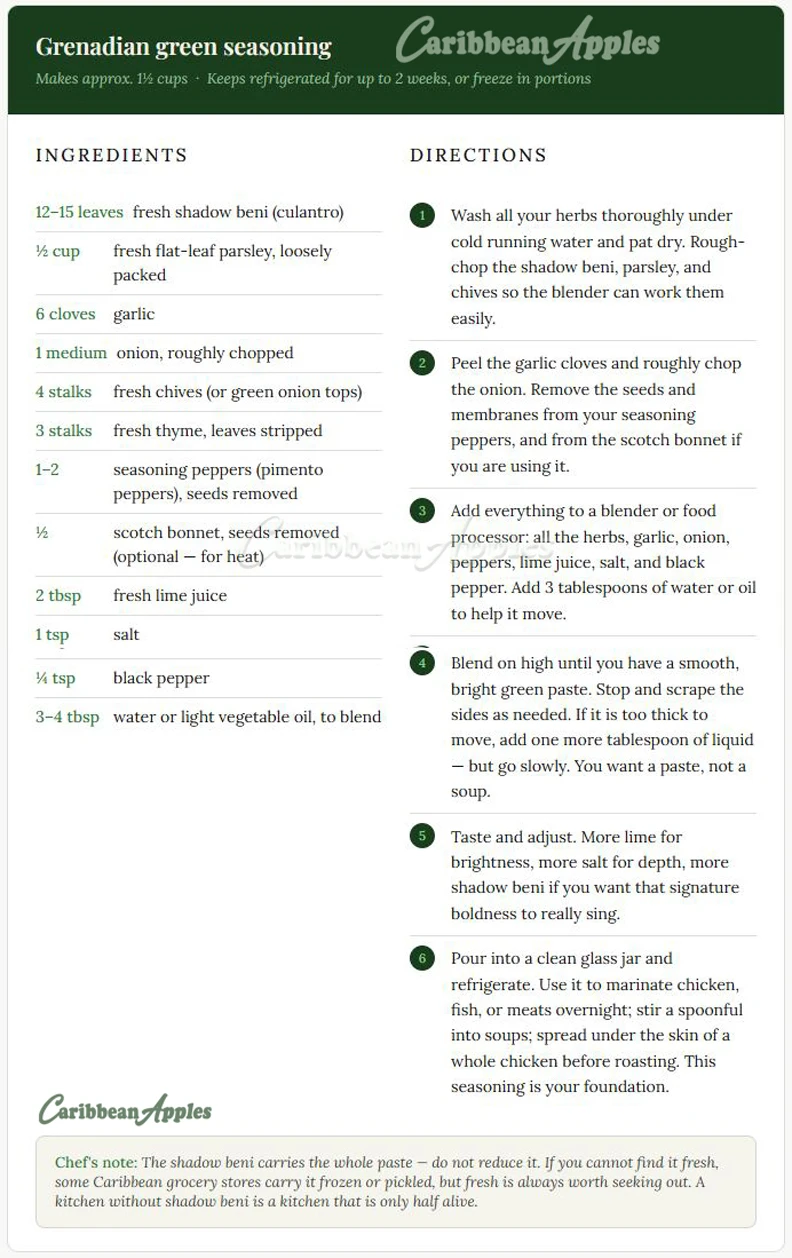
Beyond any single dish, the most important use of shadow beni on the island is in green seasoning — the all-purpose marinade and flavor paste that is the true heart of Grenadian cooking. Every family has their version, passed down through generations, adjusted here and there, but always with shadow beni at the center.  - See shared recipe.

Put on that Chef's Apron and make your own Grenadian Green Seasoning

Grenadian Green Seasoning Recipes - Caribbean Apples

CaribbeanApples.com

Image

Caribbean Apples Dispatches - North Leeward Coast 

A Fruit With A Complicated Past

The story begins properly in 1793, when Captain William Bligh — of Mutiny on the Bounty notoriety — completed his second Pacific voyage aboard HMS Providence and delivered breadfruit plants from Tahiti to the West Indies. The purpose was grimly utilitarian: plantation owners required a cheap, prolific food to sustain enslaved workers. Breadfruit asked little of the soil and gave generously in return. It spread quickly, became ubiquitous, and for that very reason carried a stigma long after emancipation. It was the food of people with no choice in the matter.

What followed is a story of remarkable transformation. Vincentian cooks, across generations, took this imposed crop and worked it into something magnificent — roasted over coal pots, fried to golden crispness, stewed with saltfish, pressed into pastry. They invented a cuisine from the ingredients of hardship.

Today, the Breadfruit Festival is held each August, deliberately aligned with Emancipation Month. The pairing is intentional and eloquent. This fruit, once the ration of the enslaved, is now the centerpiece of a national celebration.

The Festival Itself: August on the North Leeward Coast

The Breadfruit Festival is not contained to a single afternoon. Throughout August, events move between communities along St. Vincent's North Leeward coast — the wilder, less-traveled side of the island, where fishing villages meet the sea and the mountains press close behind them.

Imagine a community gathering that can only be described as a village reunion with exceptional food. The road had been given over to trestle tables draped in green and yellow. A steel pan band warmed up at one end, their notes drifting pleasantly out over the water.

The vendors are the soul of the occasion. A warm, golden-crusted breadfruit cheese pie — savory, gently spiced and made to a thirty-year-old recipe. Breadfruit puffs, deep-fried and pillowy. There’s breadfruit lasagna and breadfruit pizza with a dense, authoritative crust. Children moving through the crowd clutching cups of breadfruit candy. A chilled breadfruit punch, subtly sweet and faintly floral.

Food fair presentations circulate to different communities throughout the month, each bringing its own recipes and traditions. Small exhibitions explain the plant's broader uses — the dense, water-resistant wood for building and boat-making, the sap for medicine, the great architectural leaves in local craft and art. The breadfruit, one comes to understand, is not merely a foodstuff. It is a material, a remedy, a symbol.

Music, Drumming, and the Culture of Celebration

By afternoon, the steel pan yields the stage to a calypsonian, the crowd singing along with the fluency of people who have known these words since childhood. Drumming came later — deep, insistent, the kind that arranges itself in one's chest before one is quite aware of it.

Hotels and restaurants across the island are encouraged to feature breadfruit on their menus for the duration of August. The festival, in this way, is not confined to the North Leeward gatherings — it spreads across the island's food culture for the entire month. Wherever one dines in August in St. Vincent, the breadfruit will find you.

6 Facts About Breadfruit in St. Vincent and the Grenadines

01

Over 25 varieties grow in SVG.

St. Vincent and the Grenadines cultivates more than 25 distinct varieties of breadfruit, a testament to centuries of agricultural entrenchment since the fruit's introduction.

02

It is the national dish.

Roasted breadfruit with fried jackfish is the official national dish — found on tables from upscale Kingstown restaurants to roadside stalls on the outer Grenadines.

03

Captain Bligh delivered it in 1793.

After the famous mutiny derailed his first attempt, Bligh succeeded on his second voyage, bringing breadfruit from the Pacific to the West Indies aboard HMS Providence.

04

It arrived as food for the enslaved.

Breadfruit was introduced as a low-cost crop to feed plantation workers. Its very abundance made it, for generations, a food associated with poverty — until Vincentian cooks transformed its reputation entirely.

05

It is remarkably versatile.

Depending on ripeness, breadfruit may be roasted, fried, boiled, baked, steamed, pickled, mashed, or fermented. At the festival it appears as pie, pizza, lasagna, quiche, candy, and cold drinks.

06

The whole plant has uses.

The wood has served in construction and boat-building. The sap has medicinal applications. The large leaves appear in local art and craft. Festival exhibitions present breadfruit as a complete resource, not merely a crop.

Traveler’s Notes

The Breadfruit Festival runs throughout August, with gatherings across the North Leeward communities and food presentations at various points around the island. The Ministry of Tourism, Sports and Culture may be reached at (784) 451-2180 or culturesvg@gmail.com for details.

CaribbeanApples.com

More vitamin C than almost anything on Earth.

Every visitor to this island reaches for a rum punch or a flying fish dish. Fair enough. But the thing the locals always want to put in their hands first? A tiny, tart, fire-red Bajan cherry, straight off the tree. Known to the world as the Barbados cherry — or acerola — this little fruit is one of the island's greatest gifts, and most people have no idea what they're holding.

1. Health

It has more vitamin C than almost anything on Earth

Literally. One small Bajan cherry contains roughly 65 times the vitamin C of an orange of the same weight. A single handful can deliver more than your recommended daily intake. The fruit registers between 1,000 and 4,500 mg of vitamin C per 100g — numbers that made nutritionists sit up very straight when they first studied it in the mid-20th century.

2. History

Barbados gave it its name to the world

Though the acerola plant (Malpighia emarginata) grows throughout tropical America, it was so abundantly cultivated here and so strongly associated with this island that it became known internationally as the Barbados cherry. Botanists and traders who encountered it through Barbados carried the name everywhere. Barbados didn't just grow the fruit — they put it on the map.

3. Science

Its vitamin C is exceptionally well-absorbed by the body

This is a surprise to everyone when they first learn it. The ascorbic acid in Bajan cherries is bound with natural bioflavonoids in a way that makes it significantly more bioavailable than synthetic vitamin C supplements. Studies have found that the body absorbs and retains the vitamin C from acerola more efficiently than from most other sources — natural or manufactured.

4. Nature

The tree produces fruit up to three times a year anything on Earth

One of the reasons Bajan cherries have always been woven into island life is sheer abundance. The acerola shrub can produce up to three full crops annually in our tropical climate — meaning ripe fruit is available across much of the year. The blossoms are small and pale pink, and once you recognize the tree, you start spotting it growing in yards all over Barbados.

5. Food

The riper the cherry, the sweeter — but the lower the vitamin C

Here's the twist that always gets a reaction from visitors to Barbados: the tart, barely-ripe cherry actually packs far more vitamin C than a fully ripe, sweet one. Vitamin C content drops sharply as the fruit matures and sugars develop. So the slightly sour cherry you bite into and wince at? That's the one doing the most work for you. Bajans have always known to eat them early.

6. Culture

Bajan grandmothers have used it as medicine for generations

Long before nutrition science confirmed what was happening, island folk medicine had the Bajan cherry pegged as a healer. Generations of Bajan mothers and grandmothers gave the juice to children at the first sign of a cold, used it to treat skin conditions, and brewed it into teas for fatigue. What they called "good sense" turned out to be pharmacology — they were right all along.

7. Economy

It's now a multimillion-dollar global supplement ingredient

Walk into any health food store in Tokyo, London, or New York and flip over a vitamin C supplement. There's a fair chance the words "acerola extract" appear in the ingredients. The global nutraceutical industry sources acerola powder and concentrate on a massive scale, with Brazil now the largest producer. But the fruit still carries the Bajan island's name wherever it travels — Barbados cherry, every time.

CaribbeanApples.com