Image

Oil down is the kind of food that resists a recipe card. Ask ten Grenadian cooks how to make it and you'll get ten different pots, ten different orders of operations, and ten passionate opinions about who's doing it wrong. Between kitchens, backyards, and beachside fire pits — from the nutmeg-scented hills near Gouyave to home cooks in St. George's — we take a journey to understand not just how oil down is made, but why it still matters so much to the people who make it.


A Dish Built From Survival and Solidarity

Oil down's story starts long before it had a name. Grenada's earliest inhabitants, the Amerindian peoples of the island, cultivated callaloo greens and the starchy root beneath them known as dasheen — ingredients that are still the beating heart of the dish today. Centuries later, when European colonizers brought enslaved West Africans to work the sugarcane plantations, those enslaved cooks carried with them a tradition central to West African foodways: the one-pot meal, built to stretch scarce ingredients across many mouths.

What went into that pot tells its own brutal and resourceful history. The salted meat came from the parts of the pig plantation owners didn't want — pig snout and, scraps from the master's house. Salted cod arrived from Canada as cheap, shelf-stable protein for enslaved communities. Breadfruit, that dense, starchy staple now inseparable from Caribbean cooking, made its way to Grenada from the South Pacific, following the same infamous voyage tied to Captain William Bligh and the Bounty. Generations later, after emancipation in 1834, indentured laborers arrived from South Asia and brought turmeric with them — a spice Grenadians still call "saffron" today, and one that gives oil down its signature golden hue.

In a Grenadian kitchen, there is that dish that was never really about the food alone. Making oil down has always meant gathering people. Historically, no single household could pull together everything the pot demanded, so neighbors brought what they had — a piece of meat here, a bundle of provisions there — and the pot became a shared undertaking. Today it's still cooked for exactly that reason: Independence Day fire pits, block parties, beach gatherings, and family reunions. A home cook would put it simply — oil down isn't something you make when you're alone.

Grenadians take real pride in reading their national flag inside their national dish: the green of the callaloo, the red of the carrots, and the gold of the turmeric-stained broth. It's a small but sincere piece of culinary patriotism.


The Ingredients: A Melting Pot in a Single Pot

Before you understand the recipes, you have to understand the ingredients — because in oil down, nearly every one of them arrived on the island from somewhere else, and each carries a piece of Grenada's history.


  • Breadfruit – A large, starchy fruit that forms the backbone of the dish. Originally from the South Pacific, it's peeled, cut into wedges, and cooked until tender enough to soak up the coconut broth. This is the ingredient locals consider non-negotiable; without it, most Grenadians won't call the dish "oil down" at all.
  • Dasheen (taro) and its leaves (callaloo) – The root is starchy and mild, while the leaves — cousins of spinach — wilt down into the broth and lend the dish its green color. Indigenous to the Caribbean long before colonization.
  • Green bananas and plantains – Starchy, unripe, and firm, added to bulk out the "ground provisions" alongside the breadfruit and dasheen.
  • Salted meats – Traditionally pigtail, pig snout, or salt beef, soaked and boiled beforehand to remove excess salt. Some cooks now substitute chicken or leave meat out entirely.
  • Salt fish – Usually salted cod, historically imported from Canada as an affordable protein; it adds a briny depth to the broth.
  • Coconut milk – The liquid base of the whole dish. As it simmers down over the long cook, the oil separates and rises to coat every ingredient — which is where the dish gets its name.
  • Turmeric ("saffron") – Brought by South Asian indentured laborers after emancipation, it stains the broth gold and adds a warm, earthy note.
  • Dumplings – Dense, spindle-shaped pieces of dough made from flour or cornmeal, dropped into the pot toward the end of cooking.
  • Aromatics and seasoning – Fresh thyme, chives, garlic, scotch bonnet pepper, and a local green seasoning blend go in early to build the base flavor.
  • Shadow Beni – Also known as culantro or false coriander, this long, serrated leaf tastes like a more intense, lingering cousin of cilantro. It's a backbone of Caribbean green seasoning, and in inland and estate kitchens it's often added directly to the pot for a sharper herbal note.
  • Carrots and other vegetables – Added more for color and nutrition than tradition; this is one of the more flexible parts of the recipe.

How Oil Down Changes From Region to Region

There is no single "correct" oil down — and Grenadians will tell you that themselves. The dish is famously "packed" rather than stirred: cooks layer breadfruit and meat at the bottom of the pot, vegetables in the middle, and callaloo leaves on top, and how exactly to pack it is a matter of family tradition and occasional friendly rivalry. Beyond technique, geography shapes what goes into the pot.

Along the leeward west coast, in fishing communities like Gouyave — famous for its weekly Fish Friday food festival — cooks lean toward the ocean. Fresh fish, conch, or crab often show up in the pot alongside or instead of salted meat, and the broth tends to taste lighter and more briny.

Inland and in the more agricultural parishes, where nutmeg and cocoa estates have shaped the local economy for generations, oil down tends to be heartier and more provision-forward — built around salted pigtail, salt fish, and a denser stack of breadfruit, dasheen, and dumplings, meant to feed field workers and large families after a long day.

Coastal capital-area cooks near St. George's, meanwhile, often serve a version closer to what visitors are most likely to encounter — a balanced pot with chicken or salted beef, plenty of dumplings, and a golden, well-reduced broth.

None of these are "the real one." They're all real. That's the whole point of the dish.


Two Regional Recipes

Two home cooking Grenadian Oil Down recipes — one from a coastal fishing village, one from an inland nutmeg-growing community — adapted for a home kitchen abroad.


Recipe 1: Gouyave-Style Seafood Oil Down (West Coast)

Serves 6


Ingredients

  • 1 medium breadfruit, peeled, cored, and cut into wedges
  • 1 lb dasheen (taro root), peeled and cut into chunks
  • 1 bunch callaloo leaves, washed and roughly chopped
  • 2 green bananas, peeled and halved
  • 1 lb firm white fish fillets (such as snapper), cut into large pieces
  • ½ lb cleaned conch or crabmeat (optional but traditional)
  • 2 cups coconut milk
  • 1 tbsp turmeric
  • 4 sprigs fresh thyme
  • 4 cloves garlic, minced
  • 1 bunch chives, chopped
  • 1 scotch bonnet pepper, left whole (do not pierce, to control heat)
  • 2 carrots, sliced
  • Salt and black pepper to taste
  • Dumplings: 1 cup flour, water, and a pinch of salt, kneaded and shaped into small ovals


Directions

  1. In a large, heavy-bottomed pot, layer the breadfruit and dasheen at the bottom.
  2. Add the carrots and green bananas on top of the provisions.
  3. Scatter the garlic, chives, and thyme over the vegetables, then nestle the whole scotch bonnet pepper into the pot.
  4. Pour the coconut milk over everything and sprinkle in the turmeric. Season with salt and pepper.
  5. Bring to a simmer over medium heat, cover, and cook for 25–30 minutes without stirring.
  6. Gently place the fish and conch or crabmeat on top, followed by the callaloo leaves.
  7. Drop in the dumplings, cover again, and continue cooking for another 20–25 minutes, until the liquid has reduced and the oil has visibly separated and coats the ingredients.
  8. Remove the whole pepper before serving. Serve directly from the pot.


Recipe 2: Inland Estate-Style Oil Down (Nutmeg Country)

Serves 6–8


Ingredients

  •  1 lb salted pigtail, soaked overnight and parboiled to remove excess salt
  •  ½ lb salted cod, soaked and desalted for several hours
  •  1 large breadfruit, peeled and cut into wedges
  •  1 lb dasheen, peeled and cut into chunks
  •  2 green bananas, peeled and halved
  •  1 bunch callaloo leaves, chopped
  •  2½ cups coconut milk
  •  1½ tbsp turmeric
  •  1 onion, sliced
  •  4 cloves garlic, minced
  •  4 sprigs fresh thyme
  •  1 bunch chives, chopped
  •  4–5 shadow beni leaves, finely chopped
  •  1 scotch bonnet pepper, whole
  •  2 carrots, sliced
  •  Cornmeal dumplings: 1 cup cornmeal, ½ cup flour, water, and a pinch of salt


Directions

  1. In a large pot, layer the parboiled pigtail and desalted cod at the bottom.
  2.  Add the breadfruit, dasheen, and green bananas on top of the meat and fish.
  3. Scatter the onion, garlic, thyme, chives, and shadow beni over the top, and tuck the whole scotch bonnet into the pot.
  4. Pour the coconut milk over the ingredients, then sprinkle turmeric evenly across the top. Add carrots.
  5. Cover and simmer over medium-low heat for about 45 minutes without stirring, allowing the salted meat to release its flavor into the broth.
  6. Layer the callaloo leaves over the top, then add the cornmeal dumplings.
  7. Cover and cook for another 30 minutes, until the liquid has cooked down almost completely and the pot has taken on a thick, golden coating of oil.
  8. Remove the pepper, taste for salt, and serve hot.

How They Differ

The Gouyave version is built around the sea — fresh fish and shellfish go in late and cook gently, keeping the broth lighter and briny, with a shorter overall cooking time since there's no salted meat to tenderize. The inland estate version leans on salted, cured proteins that need a longer simmer to release their flavor and soften properly, giving the dish a deeper, saltier, more robust broth, and it swaps in cornmeal dumplings — heartier and denser than the flour version — reflecting a tradition built to fuel long days working the land rather than the sea.


Grenadian Artwork

Oil down isn't a fixed formula — it's a method for turning whatever a community has on hand into a meal worth gathering around. Every region's version carries its own geography, its own labor history, and its own family memories packed into the same pot. That, more than any single ingredient, is the real recipe.

Image

When a single ingredient stops a chef cold — not with its aroma, not with its color, but with a kind of primal warning that says: proceed with respect. This ingredient is a small, wrinkled red pod locals call simply, "de Scorpion."

The Trinidad Moruga Scorpion (Capsicum chinense) is not merely a chili pepper. It is a living piece of Caribbean heritage, a botanical marvel, and — for a period that the pepper world will never forget — the undisputed hottest chili pepper on Earth.


A Pepper Born from Volcanic Soil and Caribbean Sun

Trinidad and Tobago, a twin-island republic perched at the southern end of the Caribbean chain, just seven miles off the coast of Venezuela, has always been a place of extraordinary biodiversity. The island's volcanic soil, tropical humidity, and fierce equatorial sun create conditions that push plants to their limits — and the Moruga Scorpion is the ultimate expression of that terroir.

The pepper takes its name from the Moruga district, a rural, coastal community in south-central Trinidad, where it has been cultivated for generations by local farmers. Long before any food scientist pointed a Scoville meter at it, Trinidadian cooks knew what they had. They treated it not as a stunt or a spectacle, but as a condiment — something to be used with wisdom, sparingly, to bring a dish alive.

The Crown: World's Hottest Pepper (2012)

In February 2012, the New Mexico State University Chile Pepper Institute made it official. After rigorous testing, they announced that the Trinidad Moruga Scorpion had surpassed all known rivals, registering an average of 1,207,764 Scoville Heat Units (SHU), with individual specimens testing as high as 2,009,231 SHU. For context, a standard jalapeño sits somewhere between 2,500 and 8,000 SHU. The Moruga Scorpion didn't just beat the competition — it lapped it.

It held the Guinness World Record title until 2013, when the Carolina Reaper — bred in South Carolina — edged it out. But in the culinary world, records aren't everything. The Moruga Scorpion retained something the Carolina Reaper and its successors have always struggled with: flavor.

The Flavor Behind the Fire

Every cook to use it understands, The Moruga Scorpion is not a one-dimensional weapon. Beneath that volcanic heat lies a complex, almost tropical fruitiness — notes of cherry, a whisper of chocolate, and a subtle floral sweetness that blooms in the first half-second before the capsaicin storms in like a slow-moving hurricane. It is, in the truest sense, a complete flavor experience.

The heat itself has a distinctive character: it builds gradually, peaks intensely, and lingers — sometimes for 30 minutes or more. It doesn't hit your tongue the way a habanero does; it spreads across the entire palate and eventually settles, with an almost meditative heat, deep in the chest and throat.

For a chef, this makes the Moruga Scorpion one of the most challenging and rewarding ingredients to work with. They are not just managing heat — They are composing with it.

Famous Dishes of Trinidad That Honor the Scorpion

Trinidadian cuisine is one of the most underrated food cultures in the world — a beautiful collision of African, Indian, Chinese, Spanish, and Indigenous Amerindian influences, all swirling together on two small islands. The Moruga Scorpion and its hot pepper cousins are woven into the very fabric of this cooking.

About

Pepper Sauce

If there is one non-negotiable artifact of Trinidadian food culture, it is the homemade pepper sauce. Every family has a recipe. Every kitchen counter has a bottle. Moruga Scorpion pepper sauce is typically made with the raw pepper blended with vinegar, mustard, chadon beni (culantro), garlic, and lime juice. The result is a condiment of extraordinary complexity — fruity, acidic, deeply hot, and utterly addictive. No doubles, no bake-and-shark, no roti is complete without it.


Doubles

Speaking of doubles — this is Trinidad's beloved street breakfast: two soft, fried bara (flatbreads made with turmeric and flour) stacked with curried chickpeas (channa), topped with tamarind chutney, cucumber, and — crucially — as much pepper sauce as you can stand. It is one of the greatest street foods on earth, and the Scorpion pepper sauce is what separates a good doubles from a transcendent one.


Curry Goat

Trinidadian curry is its own distinct tradition, shaped heavily by Indo-Trinidadian cooking. A proper curry goat slow-cooked with geera (cumin), Trinidadian curry powder, and a whisper of Moruga Scorpion is one of the most satisfying things you will have ever eaten. The pepper's fruity depth melds into the braising liquid, creating a sauce with remarkable layers — earthy, warm, quietly incendiary.


Bake and Shark

At Maracas Beach on Trinidad's north coast, vendors have been frying shark fillets and stuffing them into fried bake (a pillowy fried bread) for decades. Bake and Shark is a national institution. The toppings bar typically includes garlic sauce, tamarind, pineapple, and, always, the hot pepper sauce. When that sauce is built on Moruga Scorpion, the combination of cool ocean air, crispy bread, and volcanic heat is something approaching the divine.


Pelau

Pelau is the ultimate Trinidadian one-pot: chicken (or beef), pigeon peas, coconut milk, and rice all cooked together with caramelized sugar and aromatic herbs. A Scotch bonnet or a sliver of Moruga Scorpion added during cooking doesn't make the dish "hot" in the aggressive sense — it infuses the entire pot with a warming, fruity undercurrent that is the hallmark of great Caribbean cooking. Heat as seasoning, not as shock.


When you cook with the Moruga Scorpion, you are also cooking with the history of a people who built extraordinary culinary traditions under extraordinary circumstances. You are working with the labor of Trinidadian farmers in the Moruga district who cultivated this pepper for generations before the world ever came looking. That story belongs on the plate, too.

The records have moved on. The Carolina Reaper took the crown. Others have since claimed to push even further. But in the kitchens of every serious cook who has taken the time to understand it, the Trinidad Moruga Scorpion remains the most interesting pepper in the world.


CaribbeanApples.com

Image

Grenadian Kitchens · Spice Isle Traditions

A brief guide to the herb that makes Grenadian food speak.

If you ever step into a Grenadian kitchen — whether it is a big restaurant in St. George's or a small wooden house up in the hills of St. Andrew's — one smell will greet you before anything else. Something green, sharp, a little wild, with a depth that no other herb can match. That is shadow beni. And if you do not know shadow beni, my friend, you do not yet know Grenadian food.


"Grenadians say 'shadow beni' but their neighbors say 'chadon beni,' 'culantro,' 'bandhania' — the herb has travelled the whole world, but it always feels most at home in Grenada."

What is shadow beni?

Shadow beni (Eryngium foetidum) is a broad-leafed herb with serrated, saw-like edges that grows close to the ground. It belongs to the carrot family — the same family as your regular cilantro — but do not make the mistake of treating them as equals. Shadow beni is bolder, more pungent, and far more persistent. Where cilantro wilts in heat and loses its scent, shadow beni holds firm. It thrives in our tropical sun, in damp soil, growing in patches along fence lines and kitchen gardens all over the island. The flavor is like cilantro turned up to three times the volume, with a faint citrus edge and an almost anise-like warmth underneath.

The name "shadow beni" — which is use throughout the English-speaking Caribbean — is thought to derive from the French "chardon béni," meaning "blessed thistle," a nod to both its serrated leaves and its perceived healing properties. In Trinidad and Tobago they say "chadon beni." In South America, where it is also widely used, you will hear "culantro" or "recao." But Grenadians have always called it shadow beni, and that name carries all the history in it.

A brief history

Shadow beni is native to tropical America and the Caribbean, and it has been cultivated and used in cooking throughout the region for centuries. It was well established in the kitchens of indigenous Carib and Arawak peoples long before European contact — used not only for flavor, but as a medicinal plant to treat fevers, chills, and stomach ailments. When the French and later the British colonized Grenada, and when enslaved Africans were brought to the island, they encountered this herb growing wild in the forests and adopted it wholeheartedly into their cooking. It was practical: it grew without much effort, it kept in heat without wilting, and it gave dishes an aroma that simply could not be replicated with dried spices from Europe.

Through the centuries of plantation life and the eventual emergence of a distinctly Grenadian cuisine, shadow beni became woven into the culinary identity the way nutmeg and mace became an agricultural identity. After emancipation in 1834, when freed people established their own gardens and kitchens, shadow beni was one of the first herbs planted. It was the people's herb — free, abundant, powerful. Today it remains a staple in every market, every garden, and every serious cook's repertoire on the island.

Shadow beni in Grenadian dishes

There are very few savory dishes in Grenada’s tradition that do not benefit from shadow beni. Here are the ones where you will feel its presence most powerfully:

Oil Down

The national dish — shadow beni is essential in the seasoning base alongside coconut milk and breadfruit

Stewed Chicken

Marinated overnight in green seasoning where shadow beni leads the flavor

Fish Broth

Added fresh toward the end so the herb perfumes the whole pot

Callaloo Soup

Blended into the creamy dasheen leaf base to lift the earthiness

Pelau

The rice-and-pigeon-pea one-pot draws deep flavor from shadow beni in the sofrito

Curry Dishes

Lamb and goat curries use it to balance the heat of the curry powder

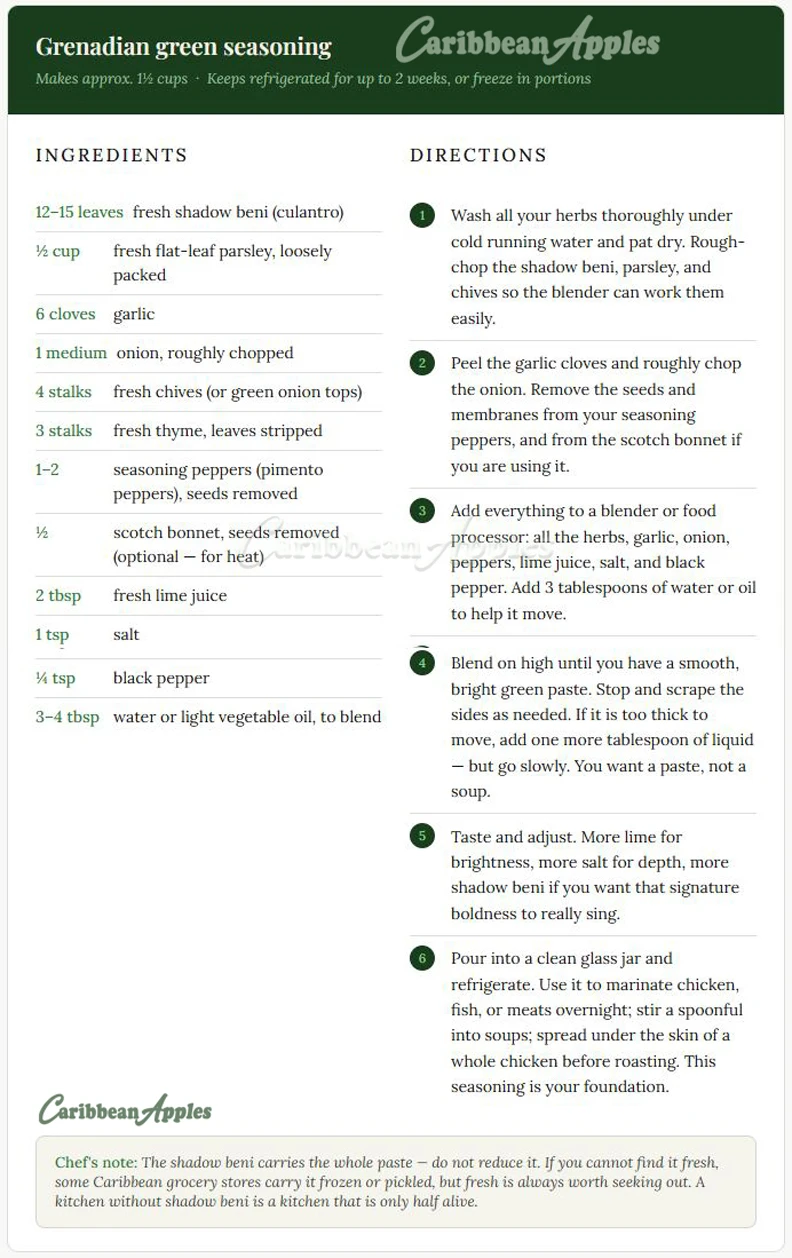
Beyond any single dish, the most important use of shadow beni on the island is in green seasoning — the all-purpose marinade and flavor paste that is the true heart of Grenadian cooking. Every family has their version, passed down through generations, adjusted here and there, but always with shadow beni at the center.  - See shared recipe.

Put on that Chef's Apron and make your own Grenadian Green Seasoning

Grenadian Green Seasoning Recipes - Caribbean Apples

CaribbeanApples.com